
Abstract
What do 80,508 people across 159 countries really want from AI?
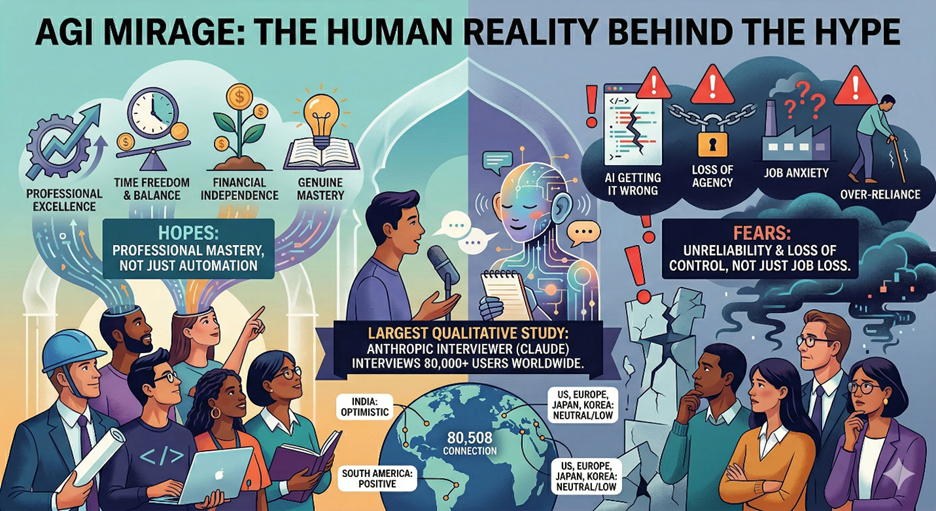
Anthropic deployed an AI interviewer to find out. The largest qualitative study of its kind reveals that users’ top hope is not automation, it is professional excellence. Their number one fear is not job loss: it is AI getting things wrong.
The article breaks down regional divides (optimism in India and South America, neutrality in the US and Europe) and explores the ironic twist: AI is now helping us understand ourselves better. Yet the mirage persists, confusing raw capability with genuine understanding. Read to learn why reliability, not superintelligence, is the real frontier.
In our first AGI Mirage article, we examined how AI dazzles us with mathematical breakthroughs such as solving problems that stumped humans for decades, while still lacking genuine meta‑reasoning. In the second, we looked at coding and security, concluding that AI automates tasks but not the deeper expertise that defines engineering. Both articles focused on what AI can do.
But there is another dimension to the mirage: what people want from AI, and what they fear. The gap between technical capability and human expectation is perhaps the most consequential illusion of all.
The mirage is the belief that AI replaces human expertise. The reality is that it amplifies it, but only when we understand what people truly want and fear.
The Largest Qualitative Study Ever Conducted
In December 2025, Anthropic did something remarkable. They deployed a version of Claude dubbed Anthropic Interviewer to conduct open‑ended, conversational interviews with 80,508 users across 159 countries and seventy languages. The goal was to understand what people truly hope for from AI and what keeps them awake at night.
The scale is staggering. Traditional qualitative research might interview dozens of people. Anthropic interviewed eighty thousand in a single week. This is not just a study; it is a proof of concept for AI as a research instrument at scale.
The results, released recently, offer a rare window into the collective psyche of AI users worldwide.
What People Want: More Than Productivity
When asked what they hope AI will do for them, the most common response was professional excellence. Not “write my emails faster” or “automate my spreadsheets,” but genuine mastery and growth in their work. People see AI as a tool to become better at what they do, not just to do it faster.
Beyond professional aspirations, respondents spoke of freeing up time, financial independence, and broader life management. These are not narrow technical hopes; they are deeply human desires for autonomy, balance, and purpose.
What People Fear: Getting It Wrong
If the hopes are aspirational, the fears are visceral.
The single most reported concern was AI getting things wrong. Not job loss, not privacy violations, not even malicious use, though all of those ranked highly. The fear that loomed largest was simply unreliability.
People are not afraid of AI being too powerful; they are afraid of AI being too untrustworthy. They want to rely on it, but they cannot yet fully trust it.
Close behind were job anxiety, losing personal agency, and over‑reliance. These are the classic fears we all know. But the fact that “getting things wrong” outranked them all suggests something deeper: users are more concerned about the quality of AI’s output than about their own displacement. They want to work with AI, but only if it works correctly.
A Global Divide in Sentiment
The study also revealed striking regional differences in AI sentiment.
- India and South America scored above average in positive sentiment.
- The United States, Europe, Japan, and South Korea ran neutral or below.
Why the divergence? The study does not claim causality, but the pattern is suggestive. In regions where digital transformation has been rapid and where AI is seen as a tool for leapfrogging infrastructure gaps, optimism runs high. In mature economies, where AI is often perceived through the lens of job displacement and regulatory uncertainty, sentiment cools.
This regional nuance is exactly what large‑scale surveys miss. Headline numbers like “52% of Americans are worried about AI” flatten the reality. The truth is more textured, shaped by culture, economic context, and lived experience with the technology.
The Ironic Twist: Claude as Interviewer
There is a deeper layer to this study that aligns perfectly with our AGI Mirage theme.
Claude, the same AI that users are both hopeful about and wary of, conducted these interviews. It parsed responses, asked follow‑up questions, and generated the qualitative data that now informs our understanding of human attitudes toward AI.
In other words, AI is now helping us understand ourselves better.
This is not AGI. Claude did not design the study, interpret the findings, or draw the conclusions. But it did something that was impossible at scale just a few years ago. It engaged in 80,000 nuanced, multilingual conversations and surfaced patterns that would have taken a human research team years to gather.
This is the quiet revolution. Not the headline‑grabbing “AI solved a 50‑year math problem,” but the slow, steady integration of AI into the fabric of how we learn about the world and about ourselves.
What This Means for the Mirage
The AGI Mirage is the seductive belief that we are on the cusp of a thinking machine. The reality is more complex and, in some ways, more interesting.
- AI can solve math problems that stumped humans for generations, but it still cannot choose which problem to work on next.
- AI can write nearly all the code at Anthropic, but great engineers are more valuable than ever.
- AI can interview 80,000 people about their hopes and fears, but the meaning of those interviews still requires human interpretation.
What the Anthropic study reveals is that people are not waiting for AGI. They are already using AI, forming aspirations around it, and developing fears about it. Their hopes are not about superintelligence; they are about professional growth, time freedom, and financial independence. Their fears are not about a machine takeover; they are about unreliability, loss of agency, and getting it wrong.
Conclusion: The Real Frontier
The next wave of AI will not be defined solely by benchmark‑beating models. It will be defined by how well these systems align with human hopes and address human fears.
As we continue this series, we will keep one foot in the technical breakthroughs, the matrix multiplications, the code‑generating agents, the security tools. But we will also keep the other foot grounded in the human reality. Because the ultimate test of AI is not whether it can reason, but whether it can be trusted.
Key Takeaways
- Hopes Are Aspirational, Not Defensive – Users want AI to help them achieve professional excellence and life balance, not merely to replace their work.
- Reliability Outranks Job Loss as a Fear – The top concern is AI “getting things wrong,” reflecting a desire for trustworthiness over fears of displacement.
- Sentiment Varies Widely by Region – Optimism is higher in India and South America than in the US, Europe, and Japan, showing that cultural and economic context shapes attitudes.
- AI Is Becoming a Research Instrument – The scale and depth of the Anthropic study demonstrate a new capability: using AI to understand human society at unprecedented scale.
- The Real Mirage Is Abstraction – We must look beyond aggregate numbers and headline breakthroughs to the textured, human reality of how AI is already being used and perceived.