
The Stakes Have Never Been Higher
The numbers are sobering. 95% of generative AI pilots fail to reach production, according to MIT’s NANDA initiative. RAND Corporation tracked an 80% failure rate for AI projects, double the rate of regular IT projects. IDC found that 88% of AI prototypes get built and then shelved. BCG reports that 74% of companies struggle to achieve any AI value. And in 2025 alone, 42% of companies abandoned most of their AI initiatives, up from just 17% the previous year.
What makes these numbers particularly alarming is that they are rising, not falling. As AI technology becomes more powerful and accessible, the failure rate is accelerating.
Why? The model is rarely the main problem. Most projects fail not because the algorithm underperformed, but because leaders skipped the crucial steps of governance, data preparation, and strategic alignment early in the process. Omdia’s 2025 survey confirms that proof-of-concept failure “is not usually because of inherent defects in the AI technology being tested, but because enterprises and vendors do not understand the complexity of what AI deployment involves”.
McKinsey found that change management costs three times more than the technology itself. The technology is the easy part. The hard part that determines success or failure happens before a single line of code is written.
Generative AI and AI-powered code generation have fundamentally altered the competitive landscape. As one analysis notes, “moats have been steadily shrinking, and in today’s hyper-competitive, AI-driven, open source dominated landscape, they’ve all but disappeared”.
Anyone can now build an AI application. The core technology stack is owned by a handful of high-tech companies. Code generation tools like Claude, GitHub Copilot, Windsurf and Antigravity have democratized development to the point where technical implementation is no longer a differentiator.
The Discovery Vector Perspective
In Issue 4 of AI Project Pulse, we introduced the concept of Discovery Vectors continuous lenses applied throughout the AI project lifecycle rather than sequential phases to be completed and closed.
Value Discovery is the vector that operates during Ideation & Feasibility. It asks one fundamental question: Is this problem worth solving with AI, and will it deliver measurable value?
This is not a one-time checkbox. Value Discovery is recursive. As you gather information, your understanding evolves. As you prototype, you may discover that the real value lies elsewhere. As you engage stakeholders, you may uncover needs you hadn’t anticipated.
The following framework structures this discovery process into six interconnected investigations.
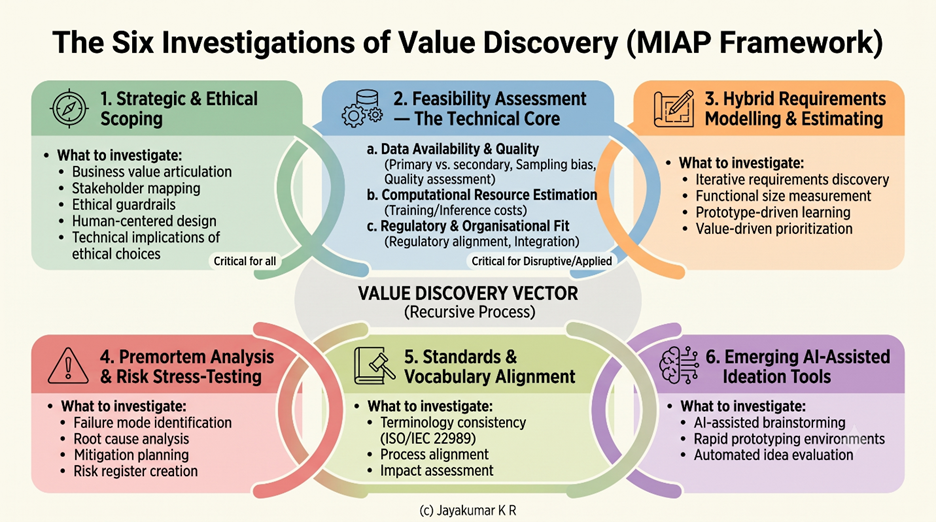
The Six Investigations of Value Discovery
1. Strategic & Ethical Scoping
Before any code is written, the team must articulate clear business goals mapped to measurable outcomes. This is not a bureaucratic exercise; it is the foundation upon which everything else is built.
What to investigate:
- Business value articulation: What specific business problem are we solving? What is the cost of not solving it? What measurable improvement will define success?
- Stakeholder mapping: Who benefits from this solution? Who might be adversely affected? Whose buy-in is essential?
- Ethical guardrails: What privacy, fairness, and transparency requirements must be embedded from the start? These directly constrain technical architecture choices.
- Human-centered design: How will this AI solution serve human needs rather than replace human judgment? What is the appropriate level of human oversight?
- Technical implications of ethical choices: If we require explainability, what model architectures are feasible? If we require human-in-the-loop, what latency and UX constraints does that impose?
The critical insight: Ethical choices are not separate from technical choices. They are technical choices. Bake them in from the beginning.
2. Feasibility Assessment — The Technical Core
This is where many projects derail. Leaders fall in love with the vision and convince themselves the technical details will work themselves out. They rarely do.
a. Data Availability & Quality
Gartner warns that 60% of AI projects will be abandoned through 2026 due to lack of AI-ready data.
What to investigate:
- Primary vs. secondary sources: Do we have internal data (sensors, logs, transactions) or must we acquire external datasets? Internal data is often more valuable but may require significant preparation.
- Sampling bias assessment: Early statistical tests can reveal whether available data represents the target population. If not, the model will fail in production regardless of its accuracy in testing.
- Licensing and usage rights: Open repositories may carry restrictions that affect deployment. Commercial datasets have cost implications.
- Data quality assessment: “Preparing data for AI is a tricky and potentially costly task”. Assess completeness, consistency, and cleanliness before committing to a build.
- Data accessibility: Is the data fragmented across SharePoint, PDFs, internal tools, and outdated repositories? “Without proper data structuring and governance, even the best models cannot produce reliable outputs”.
The critical insight: If you don’t have the right data or can’t get it, the project cannot succeed. This is a hard stop, not a problem to be solved later.
b. Computational Resource Estimation
Compute costs are the second leading cause of pilot termination. McKinsey reports that uncontrolled inference costs are a primary reason projects fail to scale.
What to investigate:
- Training costs: Estimate compute, storage, and time requirements using prototype benchmarks or historical data from similar projects.
- Inference costs: For generative AI, the cost per inference can be 75 times higher than specialized models. Forecast cloud costs for production scale.
- Infrastructure requirements: Do you need GPUs, TPUs, or specialized hardware? What are the implications for deployment?
- Cost range, not point estimate: “Stay away from a point estimate, give a range that recognizes the uncertainty in estimation decisions”.
The critical insight: If the economics don’t work at scale, the project won’t be sustainable. Run the numbers before you build.
c. Regulatory & Organisational Fit
What to investigate:
- Regulatory alignment: Does your planned architecture support required audit trails, data residency, and model explainability under GDPR, EU AI Act, HIPAA, or sector-specific rules?
- Organizational readiness: Is the organization prepared for the change management required? Remember: change management costs three times more than the technology.
- Integration requirements: “A GenAI solution becomes valuable only when it fits into existing workflows”. Integration often takes longer than the AI component itself.
- Ownership clarity: “GenAI initiatives usually sit between IT, data, legal, security, and the business unit. If it is not clearly defined who owns the product after the PoC phase, the project stalls”.
The critical insight: Technical feasibility is necessary but insufficient. If the organization cannot absorb and sustain the solution, it will fail.
3. Hybrid Requirements Modelling & Estimating
Traditional requirements documents fail for AI projects because the behaviour of AI systems cannot be fully specified in advance. The APLC recommends hybrid modelling that merges user stories, data-driven insights, and prototype learnings.
What to investigate:
- Iterative requirements discovery: Requirements co-evolve with models and use cases. Plan for this rather than fighting it.
- Functional size measurement: Expert & Practitioners guides for ‘Early Software Sizing with COSMIC’ accompanying COSMIC functional sizing (ISO 19761) can quantify scope and estimate effort even when requirements are uncertain (www.cosmic-sizing.org).
- Prototype-driven learning: Build small, focused prototypes to test assumptions before committing to full development.
- Value-driven prioritization: Not all features are equal. Focus on the capabilities that deliver the most value with the least risk.
The critical insight: In AI projects, you discover requirements through building. Plan your lifecycle to support this reality.
4. Premortem Analysis & Risk Stress-Testing
Before you build, imagine failure. Host a premortem workshop and ask: “If this project fails six months from now, what went wrong?”
Common answers include:
- The data contained hidden biases that destroyed fairness indicators.
- Latency exceeded SLAs once deployed at scale.
- The model could not generalise to edge cases.
- Users rejected the solution because it didn’t fit their workflow.
- Costs spiralled beyond the budget
- Regulatory changes invalidated the approach.
What to investigate:
- Failure mode identification: Systematically identify what could go wrong — technically, ethically, operationally, and organizationally.
- Root cause analysis: For each failure mode, trace back to its root cause. What upstream decisions could prevent it?
- Mitigation planning: For the top risks, develop concrete mitigation strategies. What proof-of-concept work can validate or invalidate these risks early?
- Risk register creation: Document risks, probabilities, impacts, and mitigations in a living register that evolves with the project.
The critical insight: A premortem is not pessimism; it’s the most cost-effective form of risk management you can perform.
5. Standards & Vocabulary Alignment
Technical discovery is not guesswork. Use established standards to ensure clarity and consistency.
Key standards to reference:
- ISO/IEC 22989:2022 — Unified AI concepts and terminology
- ISO/IEC 42001:2023 — AI management system framework
- ISO/IEC 42005:2025 — Guidance for early AI system impact assessments
- ISO/IEC TR 24030:2024 — Cataloguing AI use cases
What to investigate:
- Terminology consistency: Ensure all stakeholders share a common vocabulary. “ISO/IEC 22989 supplies the vocabulary for every AI policy and SOP”.
- Process alignment: Align your lifecycle with ISO/IEC 5338 (AI system life cycle processes) and ISO/IEC 23053 (ML framework).
- Impact assessment: Use ISO/IEC 42005 to conduct early AI system impact assessments.
The critical insight: Standards are not administrative overhead; they are tools for clarity, consistency, and risk reduction.
6. Emerging AI-Assisted Ideation Tools
Technical discovery today can be augmented with GenAI co-creators. Tools that support semantic clustering, rapid prototyping, and idea funnelling allow teams to test multiple technical hypotheses in parallel.
What to investigate:
- Rapid prototyping environments: Miro’s AI-powered products “optimize discovery-to-delivery lifecycle, enabling teams to bring the right products to market faster”.
- Automated idea evaluation: Generative AI can “systematically and rapidly generate hundreds of ideas” and filter them into feasible solution concepts.
The critical insight: Guard against automation bias; human technical judgement remains final. AI tools augment, not replace, human decision-making.
Ideation & Feasibility Across AI Project Types
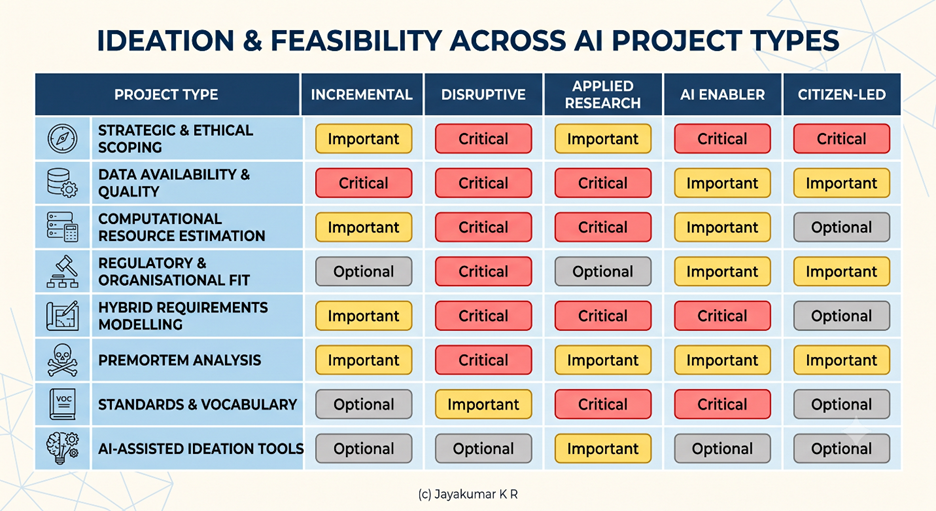
The six investigations of Value Discovery are not one-size-fits-all. Their importance shifts dramatically depending on the type of AI project you are pursuing. What is absolutely critical for a Disruptive Innovation project may be entirely optional for Citizen-Led Innovation. Understanding these differences is what separates effective project governance from organizational overreach.
Below is a project-type-specific breakdown of the Ideation & Feasibility elements, classified as:
- Critical — Must be performed; project cannot proceed without it.
- Important — Should be performed; adds significant value.
- Optional — May be performed if resources permit; situational.
1. Tailoring to Incremental Innovation Projects
Enhancing existing AI-powered applications through tuning, optimization, or feature expansion.
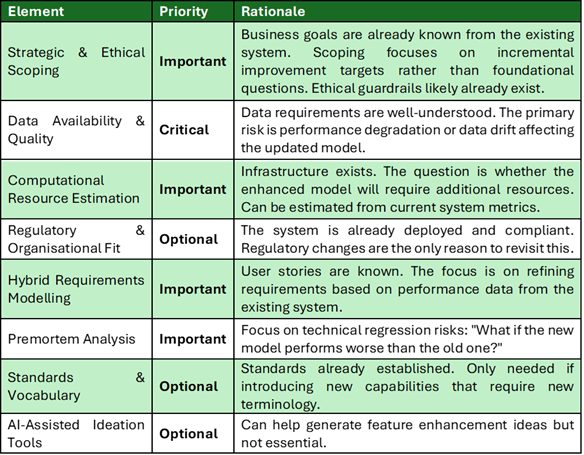
2. Tailoring to Disruptive Innovation Projects
Introducing novel AI applications that create new markets or fundamentally redefine existing ones.
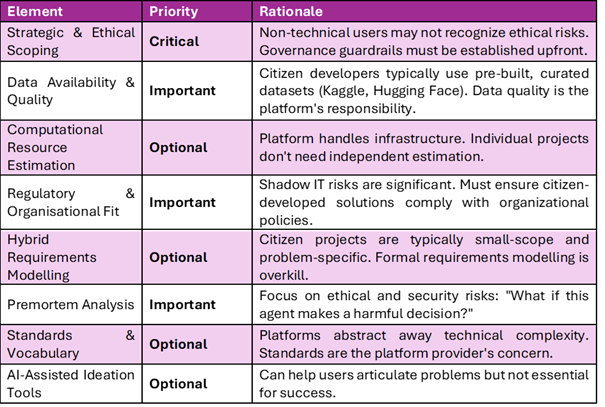
3. Tailoring to Applied Research Projects
Exploring novel algorithms, architectures, or capabilities where the path to a working solution is unknown.
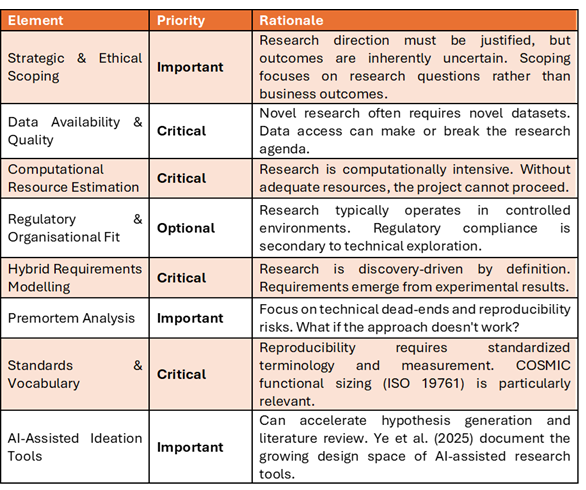
4. Tailoring to AI Enabler Projects
Building the tools, platforms, and frameworks that empower other AI projects.
5. Tailoring to Citizen-Led Innovation Projects
Empowering non-technical domain experts to create AI solutions using no-code/low-code platforms.
Summary: Ideation & Feasibility Priority Matrix
The Go/No-Go Decision
At the end of Ideation & Feasibility, the team must answer: Do we have sufficient evidence that this AI initiative will deliver value?
A GO decision requires:
- A clear, measurable value criterion (e.g., “prototype reduces manual processing time by 40% with 90% user acceptance”)
- Identified data sources with confirmed access and acceptable quality.
- Modelling/inference budget estimated within 20% of planned spend.
- No unresolvable regulatory blockers
- A documented risk register with mitigation plans for top three value-related risks
- Clear ownership assigned for the next phase
- Stakeholder alignment and commitment
A NO-GO decision is successful discovery as it saves months of wasted effort, millions in sunk costs, and preserves organizational credibility.
Important: A GO decision at this stage means that, based on the available information, the project can be pursued further. However, this decision is not final. Any significant change in the environment such as regulatory shifts, market dynamics, data availability, or organizational priorities requires revisiting the Go/No-Go decision at subsequent stages of the AI Project Life Cycle.
What Ideation & Feasibility Means for Your AI Project
Value Discovery is the most leveraged investment you can make. It answers, “should we?” before you commit to “how we will.”
The companies succeeding with AI aren’t the ones with the biggest budgets or the most advanced models. They are the ones who “identify a specific problem, build a specific solution, measure specific results”. They are the ones who treat AI “like any other tool” rather than a magic wand.
The most common mistake in AI project management is applying the same Ideation & Feasibility rigor to every project type.
- Incremental Innovation projects fail when teams over-invest in discovery that should have been quick;
- Disruptive Innovation projects fail when teams under-invest in discovery and discover too late that the fundamentals don’t work;
- Applied Research projects fail when teams treat them like product development rather than exploration;
- AI Enabler projects fail when teams forget that governance is a feature, not an afterthought;
- Citizen-Led projects fail when teams skip governance entirely and create unmanageable shadow AI.
The right level of rigor at the right time is the difference between success and failure.
References
- COSMIC Measurement Manual v5.0. Principles, Definitions & Rules
- Gartner (2025). Predicts 2025: AI and Data Management
- Early Software Sizing with COSMIC, Experts/ Practitioners Guide (www.cosmic-sizing.org)
- IBM Institute for Business Value (2025). 2025 CEO Study
- IDC (2025). AI Prototype Abandonment Study
- ISO/IEC 19761:2011. Functional size measurement — COSMIC method
- ISO/IEC 22989:2022. AI concepts and terminology
- ISO/IEC 42001:2023. AI management system framework
- ISO/IEC 42005:2025. Guidance for early AI system impact assessments
- McKinsey Global Institute (2025). The state of AI in production
- MIT NANDA Initiative (2025). The GenAI Divide: State of AI in Business 2025
- Omdia (2025). AI Market Maturity 2025 Survey
- RAND Corporation (2025). AI Project Failure Rate Study
- S&P Global (2025). Voice of the Enterprise Survey
This newsletter series is based on “Managing Innovative AI Projects” (Jayakumar K R and Prof. Alain Abran, 2025).
Share your value discovery stories or how you approach Ideation & Feasibility: ManageAIprojects@gmail.com
© 2026, Jayakumar K R. All rights reserved.
This article and all its contents—whether in this form or any other form, format, or media—may not be copied, reproduced, distributed, adapted, translated, or quoted in whole or in part without the prior explicit written permission of the author.
Unauthorized use, sharing, or reproduction of this material is strictly prohibited.