
Abstract
In the first issue of AI Project Pulse, we introduced the AI Project Typology—a framework for understanding the five distinct faces of AI innovation. In this second instalment, we move from framework to reality. Rather than leaving you with abstract categories, this edition offers a curated field guide: five projects from each of the five types, selected because they best illuminate what Incremental Innovation, Disruptive Innovation, Applied Research, AI Enablers, and Citizen-Led Innovation actually look like in practice.
From Amazon’s smarter Alexa and Netflix’s hyper-personalised thumbnails to OpenAI’s reasoning models and India’s sovereign BharatGen initiative, each project is examined through a consistent lens: What is it? Who does it serve? What does it produce? Why does it belong in its category?
You will encounter research breakthroughs from DeepMind and Meta, enablers like LangChain and Hugging Face that power countless applications, and citizen-led stories—including a child building a library app for their housing society and a fitness instructor creating a website with zero code. Whether you lead AI initiatives, build them, or fund them, this issue will train your eye to recognise the type of project you are dealing with—and what that means for how you should manage it.
Welcome to the second instalment of our series on AI Project Typology. In Issue 1, we laid the foundation defining the five distinct types of AI projects and why recognising your project’s category is the first step toward success.
In this second part of the series, we bring those categories to life.
Rather than overwhelming you with an exhaustive catalogue, I have listed five projects from each category, the ones that best illuminate the essence of their type. These are the projects that make the abstract tangible, which show you what “Incremental Innovation” or “Disruptive Innovation” actually looks like in the wild.
For each project, we will explore:
- What it is and why it matters
- Who it serves (its primary users)
- What it produces (its key output)
- Why it belongs in its category.
Think of this as your field guide, a way to train your eye to spot the type of AI project you might be leading, joining, or funding. Let us have a quick recap of the five AI Project Types.
Incremental innovation projects refine what exists. They are about better recommendations, better voice assistants, better writing help. They serve existing users with enhanced versions of familiar tools.
Disruptive projects create what did not exist. They are about new new capabilities, new markets, new possibilities. They often face adoption challenges because users must learn to want something they have never had.
Applied research explores what might exist. They are about knowledge, understanding, discovery, proof. They may not serve users directly or immediately; they serve the future.
AI enablers multiply what is possible. They are about power, giving builders better tools, faster iteration, stronger governance. They are invisible to end-users but essential to everything users experience.
Citizen-led projects democratise who builds. They are about ownership, letting domain experts solve their own problems. They represent AI’s potential to amplify human expertise rather than replace it.
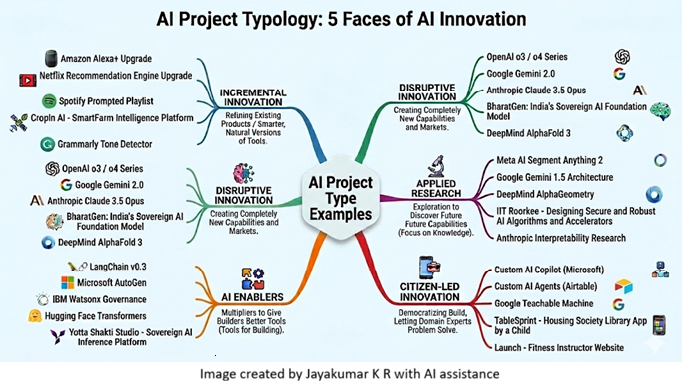
1. Incremental Innovation: The Art of Making Good Better
These projects do not reinvent the wheel, they make it roll smoother, faster, and more reliably.
Incremental Innovation Projects
Project #1: Amazon Alexa+ Upgrade
What it is: Amazon’s flagship voice assistant received a significant upgrade in late 2025, gaining the ability to maintain free-flowing conversations without requiring the wake word “Alexa” for every follow-up. It now remembers context across sessions and delivers personalised news summaries based on user preferences.
Primary Users: Smart home users, Amazon Echo device owners, anyone who talks to Alexa at home.
Key Output: An enhanced voice assistant that feels more like a conversation partner than a command-line interface.
Why It is Incremental: Alexa already existed. This is not a new product category, it is a smarter, more natural version of the same assistant. The core technology remains, but its conversational abilities have been refined and expanded.
Project #2: Netflix Recommendation Engine Upgrade
What it is: Netflix integrated behavioural data from its 325 million subscribers to fine-tune its recommendation algorithms. The upgrade now personalises not just which movies appear, but how they appear with customised thumbnails and row configurations tailored to individual viewing habits.
Primary Users: Netflix subscribers across all 190+ countries where the service operates.
Key Output: Hyper-personalised content discovery, the right movie, with the right thumbnail, at the right moment.
Why It is Incremental: Netflix has always had recommendations. This upgrade makes them more intelligent and visually personalised, but the fundamental experience of browsing and watching content remains unchanged.
Project #3: Spotify Prompted Playlist
What it is: Spotify now allows users to generate custom playlists simply by describing what they want in natural language. Type “songs for a rainy Sunday morning with my cat” or “upbeat workout mix from the 90s,” and AI instantly curates a playlist matching the mood and context.
Primary Users: Spotify’s free and premium listeners who want personalised music discovery.
Key Output: AI-generated playlists based on natural language prompts, delivered instantly.
Why It is Incremental: Spotify’s Discover Weekly and Daily Mixes have long used AI. This feature adds a new input method, a natural language making playlist generation more intuitive without changing the core music streaming experience.
Project #4: CropIn AI – SmartFarm Intelligence Platform
What it is: CropIn’s SmartFarm Intelligence platform is an existing AI-powered agricultural solution that delivers real-time insights to farmers and agribusinesses. The platform has been incrementally enhanced with advanced machine learning models that now predict pest infestations and disease outbreaks with higher accuracy by integrating hyper-local weather data, satellite imagery, and historical crop patterns across different Indian regions.
Primary Users: Farmers, agribusinesses, and agricultural extension workers who rely on data-driven insights for crop management decisions.
Key Output: Enhanced predictive intelligence delivered through mobile and web dashboards, providing early warnings on pest risks, optimal harvest timing, and yield estimates with improved accuracy.
Why It is Incremental: The SmartFarm platform already used AI for crop monitoring and weather prediction. This enhancement adds a new AI capability, advanced pest and disease prediction models to an existing AI system. The core platform remains unchanged, but its intelligence layer has been expanded to solve a new problem for the same end users.
Project #5: Grammarly Tone Detector
What it is: Grammarly expanded its writing assistant to include real-time tone analysis. As users write emails, documents, or messages, the tool now identifies the emotional tone a friendly, formal, urgent, confident and suggests adjustments to better match the intended audience.
Primary Users: Writers, professionals, students, and anyone who communicates in writing.
Key Output: Real-time tone analysis and writing suggestions that help users communicate more effectively.
Why It is Incremental: Grammarly already offered grammar and spelling corrections. This adds a new dimension of emotional intelligence to an existing, well-loved writing tool.
2. Disruptive Innovation: Creating What Wasn’t There Before
These projects do not improve existing markets; they create entirely new ones.
Disruptive Innovation Projects
Project #1: OpenAI o3 / o4 Series
What it is: OpenAI’s latest reasoning models represent a leap forward in AI’s ability to solve complex mathematical and scientific problems. These models do not just generate text—they reason through multi-step problems, verify their own answers, and demonstrate genuine progress in machine intelligence.
Primary Users: Researchers, developers, and enterprises tackling complex analytical challenges.
Key Output: Advanced AI reasoning models capable of mathematical and scientific problem-solving at near-expert levels.
Why It is Disruptive: Previous models could generate text and answer questions. The o3/o4 series introduces genuine reasoning capabilities, a fundamental shift in what AI can do, opening possibilities in scientific research, engineering, and education that simply did not exist before.
Project #2: Google Gemini 2.0
What it is: Google’s next-generation AI model features native multimodal understanding, it can seamlessly process and generate text, images, audio, and video together, understanding relationships across modalities in ways earlier models could not.
Primary Users: General public through Google products, developers building multimodal applications, enterprises seeking integrated AI solutions.
Key Output: A unified AI assistant that truly understands the world across multiple senses—seeing, hearing, reading, and speaking.
Why It is Disruptive: While earlier models could handle multiple modalities, Gemini 2.0 was built from the ground up with native multimodal understanding. This architectural shift enables entirely new applications, like pointing your phone at a machine part, hearing its sound, and getting repair instructions instantly.
Project #3: Anthropic Claude 3.5 Opus
What it is: Anthropic’s flagship model embodies “Constitutional AI”, an approach where the model is trained to understand and follow ethical principles, self-correct when it makes mistakes, and explain its reasoning transparently.
Primary Users: Enterprises requiring trustworthy AI, researchers studying alignment, developers building responsible applications.
Key Output: An AI model that not only answers questions but demonstrates why its answers are trustworthy and when users should be cautious.
Why It is Disruptive: Claude 3.5 Opus does not just add safety filters, it fundamentally understands ethical principles. This represents a shift from “controlling” AI to “teaching” AI, potentially transforming how we build trustworthy systems.
Project #4: BharatGen: India’s Sovereign AI Foundation Model
What it is: BharatGen is India’s first government-owned sovereign large language model initiative, developed from “first byte to final model” entirely within India . The initiative encompasses the 17-billion-parameter PARAM-2 text foundation model supporting all twenty-two scheduled Indian languages, along with speech recognition (Shrutam), text-to-speech (Sooktam), and document vision-language (Patram) models.
Primary Users: Government departments, public sector banks, courts, educational institutions, healthcare providers, researchers, startups, and citizens across India’s linguistically diverse regions .
Key Output: A sovereign AI ecosystem comprising foundational models (PARAM-2, Shrutam, Sooktam, Patram) and domain-specific applications including Ayur Param for Ayurveda, Agri Param for agriculture, Legal Param for the Indian legal system, MahaGPT for governance, and Medsum for healthcare.
Why It is Disruptive: While global AI models treat Indian languages as a small footnote with 2-5% training data, BharatGen fundamentally reimagines AI through the lens of India’s linguistic and cultural diversity. It does not just add Indian language support to existing models; it builds from the ground up with data sovereignty as a core principle, ensuring “nobody else has the kill switch”.
Project #5: DeepMind AlphaFold 3
What it is: DeepMind’s latest version of AlphaFold can predict not just protein structures but also how proteins interact with other molecules including DNA, RNA, and potential drug compounds revolutionising biological research and drug discovery.
Primary Users: Biologists, pharmaceutical researchers, and medical scientists.
Key Output: Accurate predictions of molecular interactions that previously required years of laboratory experimentation.
Why It is Disruptive: AlphaFold 2 transformed structural biology. AlphaFold 3 expands into molecular interactions, fundamentally accelerating drug discovery and biological understanding in ways that reshape the entire pharmaceutical industry.
3. Applied Research: Pushing the Frontiers of What’s Possible
These projects do not build products; they create knowledge that makes future products possible.
Applied Research Projects
Project #1: Meta AI Segment Anything 2
What it is: Meta’s research team developed a model that can segment any object in any video without prior training on that specific object type. The model generalises zero-shot, seeing something it is never seen and instantly identifying its boundaries.
Primary Users: Computer vision researchers and AI developers who will eventually build applications using this capability.
Key Output: A zero-shot video segmentation model and accompanying research paper.
Why It is Applied Research: This is not a product, it is a breakthrough in how machines see the world. The knowledge will eventually power everything from augmented reality to autonomous systems, but it is a research achievement.
Project #2: Google Gemini 1.5 Architecture
What it is: Google researchers developed a transformer architecture capable of processing up to one million tokens of context equivalent to whole novels or hour-long videos while maintaining coherent understanding across the entire input.
Primary Users: AI researchers studying long-context understanding and developers of future long-form AI applications.
Key Output: A long-context transformer architecture and associated research publications.
Why It is Applied Research: The million-token context window is an architectural breakthrough. It opens possibilities like AI that can read entire books or analyse full movies that researchers will now explore.
Project #3: DeepMind AlphaGeometry
What it is: DeepMind created an AI system that solves Olympiad-level geometry problems without using human demonstrations for training. The system combines a neural language model with a symbolic deduction engine, achieving performance rivalling human gold medallists.
Primary Users: AI researchers studying mathematical reasoning and educators interested in AI-assisted learning.
Key Output: A geometry theorem-proving AI system and research demonstrating neuro-symbolic reasoning.
Why It is Applied Research: This is fundamental research into how AI can combine neural and symbolic approaches. The techniques may eventually power everything from automated tutoring to scientific discovery, but today they are advancing our understanding of machine reasoning.
Project #4: IIT Roorkee – Designing Secure and Robust AI Algorithms and Accelerators
What it is: A research project at IIT Roorkee, funded by the Anusandhan National Research Foundation/SERB, focused on developing secure-by-design AI algorithms and hardware accelerators. The research addresses critical vulnerabilities in deep neural networks against adversarial attacks, patch-based attacks, fault-injection attacks, and targeted misclassification, the areas largely ignored in previous Indian AI research that focused primarily on accuracy.
Primary Users: The broader AI research community, defense and security researchers, and future product teams who will integrate these secure algorithms into applications.
Key Output: Novel methodologies for creating DNN architectures that are inherently robust to class imbalance, out-of-distribution data, fake data, and perturbations, along with techniques for ensemble-based protection and retraining-free defenses against patch attacks.
Why It is Applied Research: This project generates fundamental knowledge about AI security and creates new algorithmic approaches that will eventually enable secure AI applications in mission-critical domains like defense and healthcare. The outcomes (research papers, algorithms, design methodologies) will feed into future AI systems developed by startups, enterprises, and government agencies.
Project #5: Anthropic Interpretability Research
What it is: Anthropic’s interpretability team made significant progress in understanding how large language models actually work internally identifying features that correspond to concepts, mapping how information flows through the network, and developing techniques to “see inside” the black box.
Primary Users: AI safety researchers, interpretability scientists, and anyone concerned with understanding AI behaviour.
Key Output: Mechanistic interpretability methods, research papers, and open-source tools for analysing model internals.
Why It is Applied Research: This is not about building better products, it is about understanding what we have built. The knowledge gained will inform everything from safety to regulation, but it is fundamentally research into how AI systems think.
4. AI Enablers: Building the Tools That Build Everything Else
These projects do not serve end-users directly; they serve the people who build for end-users.
AI Enabler Projects
Project #1: LangChain v0.3
What it is: LangChain provides a comprehensive framework for building applications with large language models. Version 0.3 introduced enhanced support for agentic workflows, where AI models can use tools, make decisions, and execute multi-step tasks and improved RAG (Retrieval-Augmented Generation) pipelines.
Primary Users: AI engineers and LLM application developers who need to build complex, production-ready AI applications.
Key Output: An orchestration framework that connects language models to data sources, tools, and external systems.
Why It is an Enabler: LangChain does not serve end-users directly. It empowers developers to build applications such as chatbots, research assistants, automation tools. Without frameworks like LangChain, building sophisticated AI applications would require reinventing the wheel every time.
Project #2: Microsoft AutoGen
What it is: AutoGen is a framework for building applications with multiple AI agents that can converse with each other to solve complex tasks. Agents can specialise, one researches, another writes, a third critiques and collaborate like a human team.
Primary Users: AI developers building multi-agent systems and enterprise teams automating complex workflows.
Key Output: A multi-agent conversation framework with tools for agent orchestration, memory management, and task delegation.
Why It is an Enabler: AutoGen enables a new class of applications where AI agents work together. Developers building single-agent systems do not need it, but those pushing into agentic AI rely on it heavily.
Project #3: IBM Watsonx Governance
What it is: IBM’s comprehensive AI governance platform helps organisations monitor, document, and control their AI systems throughout the lifecycle. It includes bias detection, compliance reporting, model inventory management, and automated policy enforcement.
Primary Users: Compliance officers, AI governance teams, data scientists, and risk managers in regulated industries.
Key Output: An end-to-end governance platform with dashboards, audit trails, and automated compliance checks.
Why It is an Enabler: Watsonx Governance does not build AI, it makes AI buildable in regulated environments. Banks, healthcare providers, and government agencies cannot deploy AI without governance; this tool makes that deployment possible.
Project #4: Hugging Face Transformers
What it is: The Transformers library provides a unified API for thousands of pre-trained models such as BERT, GPT, LLaMA, and countless others. Developers can use the same few lines of code to load, fine-tune, and deploy models from any architecture.
Primary Users: ML engineers, NLP developers, researchers, and students working with transformer models.
Key Output: An open-source library with pre-trained model weights, tokenizers, and training utilities.
Why It is an Enabler: Before Transformers, using state-of-the-art NLP models required deep expertise and significant engineering effort. This library democratised access, enabling thousands of applications that would otherwise never exist.
Project #5: Yotta Shakti Studio – Sovereign AI Inference Platform
What it is: Shakti Studio is India’s most powerful browser-based AI development environment, providing data scientists and ML engineers instant access to serverless GPUs and AI endpoints for scalable model training and real-time deployment—all without managing infrastructure. Built on India’s sovereign cloud infrastructure, it offers pre-built access to industry-leading models (LLMs, Whisper ASR, TTS, Vision APIs), Bring Your Own Container (BYOC) support, and fine-tuning capabilities for generative AI models.
Primary Users: Data scientists, ML engineers, startups, enterprises, researchers, and government agencies who need to build, train, and deploy AI models without infrastructure overhead.
Key Output: A comprehensive AI platform including serverless GPU compute, production-grade inference endpoints with auto-scaling, fine-tuning tools (SFT, GRPO, DPO, LoRA/QLoRA), and real-time monitoring dashboards—all delivered as a pay-as-you-go service.
Why It is an AI Enabler: Shakti Studio does not serve end users directly—it empowers developers and organizations to build their own AI applications. A healthcare startup can use it to deploy radiology image diagnostics; an edtech company can build ASR models for Indian languages; government agencies can power citizen service automation with sovereign-compliant infrastructure. The platform abstracts all infrastructure management, allowing builders to focus purely on AI development. It is a recognized, commercially available platform built on India’s sovereign cloud.
5. Citizen-Led Innovation: When Domain Experts Become Builders
These projects empower non-technical professionals to solve their own problems with AI.
Citizen-Led Innovation Projects
Project #1: Custom AI Copilot
What it is: Microsoft’s platform allows business users to create custom AI copilots without writing code. A supply chain manager can build a copilot that monitors inventory, predicts shortages, and automatically generates purchase orders, all through a visual interface.
Primary Users: Business analysts, process owners, department managers—domain experts who understand their problems better than anyone.
Key Output: Custom AI copilots tailored to specific business workflows and integrated with existing systems.
Why It is Citizen-Led: The supply chain manager is not a developer. They know inventory management but not Python. Copilot Studio lets them apply their domain expertise directly, building solutions they own and understand.
Project #2: Custom AI Agents
What it is: Airtable integrated AI capabilities directly into its no-code platform, allowing teams to build custom AI agents that interact with their data. A marketing team can create an agent that classifies leads and generates personalised outreach copy, all within their existing workflow.
Primary Users: Operations managers, project coordinators, marketing teams, or anyone who already uses Airtable to organise work.
Key Output: AI-powered workflow agents that understand and act upon the user’s own data.
Why It is Citizen-Led: The marketing team does not need to learn ML or hire consultants. They configure AI capabilities alongside their existing spreadsheet-like interface, extending their own capabilities with minimal friction.
Project #3: Google Teachable Machine
What it is: Google’s web-based tool lets anyone train image, sound, or pose classification models using just a browser and a webcam. A teacher can build a model that recognises student hand signals; a farmer can train one that identifies diseased plants.
Primary Users: Educators, students, hobbyists, and professionals who need custom classifiers for specific tasks.
Key Output: Custom-trained classification models created without writing a single line of code.
Why It is Citizen-Led: Teachable Machine exemplifies democratisation. The teacher knows their classroom better than any AI expert. This tool lets them apply that knowledge directly, building exactly what they need.
Project #4: TableSprint – Housing Society Library App by a Child
What it is: Abhijeet Kumar, co-founder and CEO of TableSprint, shared that his daughter built a complete library management application for their housing society using the platform . With no coding experience, she simply described what she wanted in plain English, and TableSprint’s AI Consult engine translated those requirements into a functional application complete with data modelling, user interfaces, and workflows.
Primary Users: Residents of the housing society who need to manage book lending, returns, and inventory.
Key Output: A functional library management application that serves the housing society’s needs.
Why It is Citizen-Led: This example demonstrates that citizen-led innovation has no age barrier. As Kumar explains, “If you can write in English, you can code with vibe coding” . The platform’s AI Consult acts as “an analyst, developer and cloud architect rolled into one, available 24/7” , enabling anyone, even a child to become a software creator.
Project #5: Launch – Fitness Instructor Website
What it is: A fitness instructor used Launch, a Bengaluru-based AI platform, to build a complete website for managing clients, sessions, and payments . By describing their requirements in plain English: “I am a fitness instructor, I want to create a website to manage my clients, my sessions, and my payments”, the AI generated the entire stack including backend, authentication, database, and UI automatically within minutes .
Primary Users: The fitness instructor and their clients who use the website for session booking and payments.
Key Output: A professional-grade website with client management, session scheduling, and payment processing capabilities.
Why It is Citizen-Led: The fitness instructor represents the classic citizen developer, a domain expert with zero coding experience who needs a digital solution. As Prakash Sanker, Launch’s founder, explains, “You don’t need any coding experience. You can just come in, enter a prompt in plain English, and the platform will respond and do the work” .
For a detailed list of projects across all categories, check: https://manageaiprojects.ai/blog/applied-ai-project-typology-an-extended-set-of-illustrative-examples/
Key Takeaways
- Your Project’s Category Determines Your Management Mandate: The five AI project types are prescriptive tools. Incremental Innovation demands efficiency; Disruptive Innovation requires tolerance for ambiguity; Applied Research measures success by knowledge gained; AI Enablers succeed only when builders succeed; Citizen-Led Innovation lives or dies by governance. Your project type tells you what to prioritize and how to define success.
- Global and Sovereign Innovation Coexist: AI innovation spans global tech giants (OpenAI, Google) and sovereign initiatives (BharatGen, Yotta Shakti Studio). AI Project Typology applies equally to world-changing foundation models and locally relevant solutions built for linguistic diversity and data sovereignty.
- Citizen-Led Innovation Is Here: From a child building a library app to a fitness instructor creating a website with zero code, citizen-led projects are real and accelerating. The implication: empower domain experts with AI tools and govern, don’t gatekeep.
© 2026, Jayakumar K R. All rights reserved.
This article and all its contents—whether in this form or any other form, format, or media—may not be copied, reproduced, distributed, adapted, translated, or quoted in whole or in part without the prior explicit written permission of the author.
Unauthorized use, sharing, or reproduction of this material is strictly prohibited.