
The Deployment Paradox
A model rarely fails all at once. Instead, performance erodes gradually through reduced accuracy, output drift, or changing user behaviour. Prompt configuration issues follow a similar pattern, producing regressions that surface only under large-scale usage. Since neither type of failure raises infrastructure alarms, detection often comes late, after the effects have already accumulated across dashboards, operational indicators, and support channels. (“Why AI Model Deployments Break Standard CI/CD | LaunchDarkly”)
The Discovery VectorsPerspective
In Issue 4 of AI Project Pulse, we introduced the concept of Discovery Vectors, the continuous lenses applied throughout the AI project lifecycle. In Issue 6, we explored Value Discovery (Ideation & Feasibility). In Issue 7, we explored Data Discovery (Data Acquisition & Preparation). In Issues 9-14, we explored Technical Discovery (Model Design & Validation).
Reliability Discovery is the vector that operates during the Deployment & Monitoring phase. It asks one fundamental question: Does the system remain trustworthy and performant under real-world conditions?
Reliability Discovery is built around six critical investigations: Deployment Strategy & Rollout Management, Production Observability & Telemetry, Drift Detection & Performance Monitoring, Performance & Cost Monitoring, Security, Safety & Guardrails, and Feedback Loops & Continuous Improvement. Each investigation examines a distinct aspect of operational reliability, helping organizations deploy and manage AI systems with confidence. Let us begin by taking a closer look at the first investigation, Deployment Strategy & Rollout Management.
Reliability Discovery Investigation 1: Deployment Strategy & Rollout Management
Core Mandate
The operational mechanics of safely releasing a model to users is the unique core mandate. This investigation owns the enforcement of deployment gates, the automation of rollback, and the management of parallel infrastructure during rollout.
Why his Investigation Matters for Project Leaders
A model that cannot be deployed safely cannot deliver value. A rollout that lacks gates cannot be trusted. These are not technical niceties; they are operational preconditions.
- When your team cannot release a model without risking a production incident, you cannot scale.
- When your deployment process cannot detect a regression before users are affected, you cannot protect your brand.
A deployment failure discovered during a product launch is a business crisis. A rollback that takes too long is a compliance incident. Both are preventable through operational discipline during Reliability Discovery.
What to Investigate
Deployment Strategy & Rollout Management builds on Phase 3, Investigation 3: Validation Approaches, which covered controlled rollouts such as shadow testing, canary deployment, A/B testing, and interleaved testing as validation methods. Here, we focus on the operational infrastructure required to execute those rollouts safely in production: promotion gates, rollback automation, and parallel infrastructure management.
- Phase 3 asks “Is the model better?”
- Phase 4 asks “Can we release it safely, and can we recover when something goes wrong?”
1. Why Standard CI/CD Breaks for AI Workloads
Traditional CI/CD pipelines treat deployments as binary events: ship code, test it, release it. That model works for deterministic applications where the same input always produces the same output. AI systems do not work that way:
- A predictive model’s behaviour drifts as input distributions shift.
- An LLM’s outputs change with prompt configuration, context length, and model version and so does the Agent using the LLM.
Standard CI/CD breaks for AI workloads in six critical ways:
- Models are not deterministic artifacts. A registry version records training-time data, not how the model performs on today’s traffic.
- Prompt changes are deployments in disguise. Each change may require a full commit, review, staging, and production deployment cycle.
- Gradual rollouts require parallel infrastructure. Running a proper AI canary may potentially double the GPU infrastructure during the testing window.
- Staging environments do not reflect production. Production traffic changes continuously through seasonal shifts, new user cohorts, and upstream pipeline changes
- Rollback latency can cause damage. Container-based rollback takes three to eight minutes; for a high-traffic inference endpoint, which means tens of thousands of degraded interactions.
- ML and DevOps teams operate on different cadences. Manual handoffs add calendar time at deployment and slow incident response.
The deployment strategy must account for all six.
2. The Four-Stage Rollout Funnel for AI Systems
Agent and model rollout is a four-stage gate: shadow, canary, percentage, full. Each stage answers a different evaluation question. Skipping one is a recipe for a production incident.
Shadow deployment is a controlled release pattern whereby a proposed model, prompt, routing mechanism, or safety policy is evaluated against production workloads without influencing responses delivered to users. (“What Is Shadow Deployment? Definition & FutureAGI (2026)”).
- Shadow deployment is designed for comparative evaluation. Candidate models, prompts, or routing policies execute in parallel on live requests, while production continues to serve user-facing responses, ensuring that testing occurs without impacting the user experience. (“LLM Eval: Shadow Traffic and Canary in 2026 – futureagi.com”).
- Shadow deployment allows organizations to test new models on real production traffic without affecting users.
When evaluation indicators reveal a decline, such as a 1.5-point drop in Groundedness, the release can be halted immediately, even though no user has been exposed to the degraded responses.
Always start with shadow mode, even if you are confident in the change, run shadow for at least 48 hours. Look at the disagreements, not just the numbers. Run shadow before AND after recalibration.
Canary deployment serves a percentage of real users live. Canary’s job is outcomes scored on the production indicator that matters most. Do not skip canary. Canary at 5-10% for a few days catches issues that shadow cannot, because shadow cannot measure user outcomes.
For agentic systems, agent rollout is not a deploy, it is a partial behaviour change on a non-deterministic system, with blast radius across silent paths, signal that only resolves after hours of real traffic, and caches that outlive the rollback. (“Agent Rollout Strategies 2026: Four-Stage Gate”) Hold each stage for 24 to 72 hours depending on volume. The cost trade-off is important.
Multi-armed bandit deployment uses algorithms that allocate traffic to models based on performance, accelerating convergence to the best model. This pattern sits alongside shadow testing, canary releases, and champion-challenger patterns.
Blue-Green deployment is not just rollback, it is cost + latency control across environments.
Rolling deployments are tied to real-time feedback loops.
Agent and model rollout is a four-stage gate, and each stage answers a different evaluation question. (“Agent Rollout Strategies 2026: Four-Stage Gate”).
3. Deployment Strategy by System Type: Traditional ML, GenAI, and Agentic AI
The four-stage rollout funnel applies to all AI systems, but the operational mechanics differ significantly across system types. The table below maps the core deployment decisions to the three system types. This ensures that the investigation provides actionable guidance regardless of the system being built.
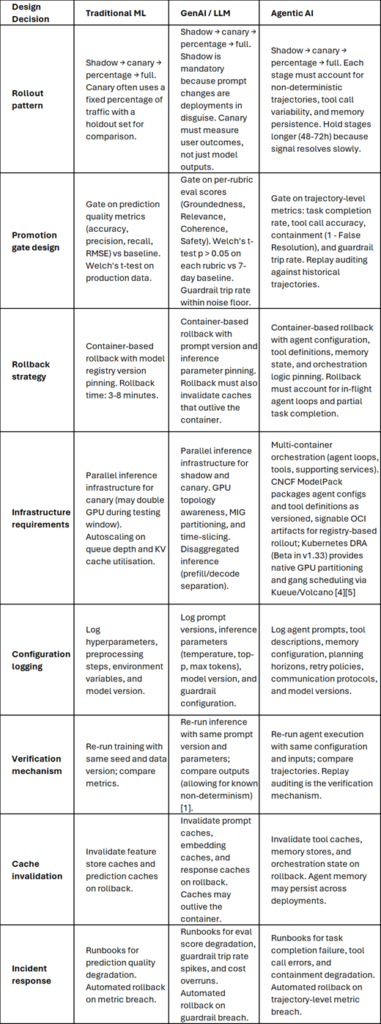
The deployment strategy is the operational foundation of Reliability Discovery.
4. The Promotion Gate Pattern: From Policy to Enforcement
Reproducibility & Scalability, discussed in the investigation 6 of Phase 3, is meant for designing the gates. Phase 4 implements the enforcement. The promotion gate pattern is the mechanism that connects the two.
A promotion gate is a set of automated checks that must pass before a candidate is promoted to the next rollout stage. Each gate has three components:
- Indicator definition: What is being measured? (e.g., Groundedness score, containment rate, p99 latency)
- Threshold: What is the passing condition? (e.g., within 1 point of production, p > 0.05, within noise floor)
- Action: What happens when the gate fails? (e.g., block promotion, alert on-call, trigger rollback)
Gate implementation patterns:
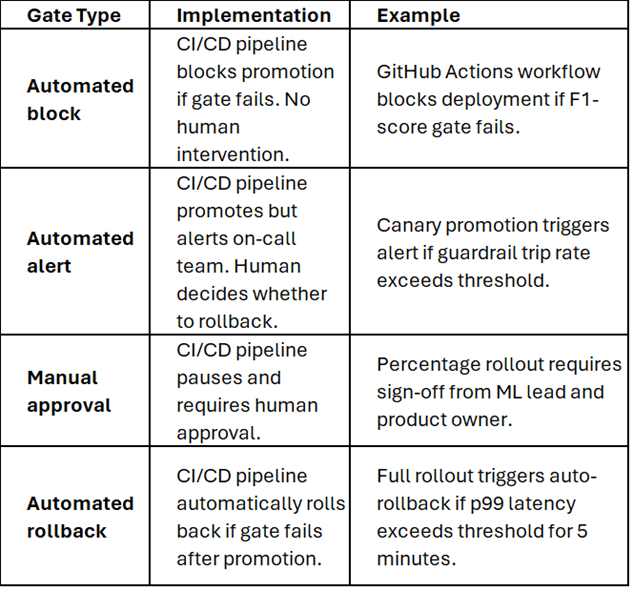
The promotion gate pattern must be implemented in the CI/CD pipeline, not in a document. Phase 3 designs the gates; Phase 4 enforces them.
5. Rollback Procedures: Testing the Safety Net
Rollback is not a failure. It is a safety net. The question is not whether you will need to rollback; the question is how quickly and safely you can rollback.
Rollback requirements for AI systems:
- Version pinning: Every model, prompt, and configuration must be pinned to a specific version. Rollback means reverting to the previous pinned version.
- Cache invalidation: Caches may outlive the container. Rollback must invalidate prompt caches, embedding caches, response caches, and agent memory stores.
- In-flight request handling: Rollback must account for in-flight requests. For agentic systems, this means allowing in-flight agent loops to complete or gracefully terminating them.
- Automated triggers: Rollback should be triggered automatically when guardrail trip rate, rubric rolling mean, or p99 latency breach thresholds.
- Runbooks: Every rollback procedure must have a runbook that defines the trigger, the steps, the validation, and the communication plan.
Rollback latency by system type:
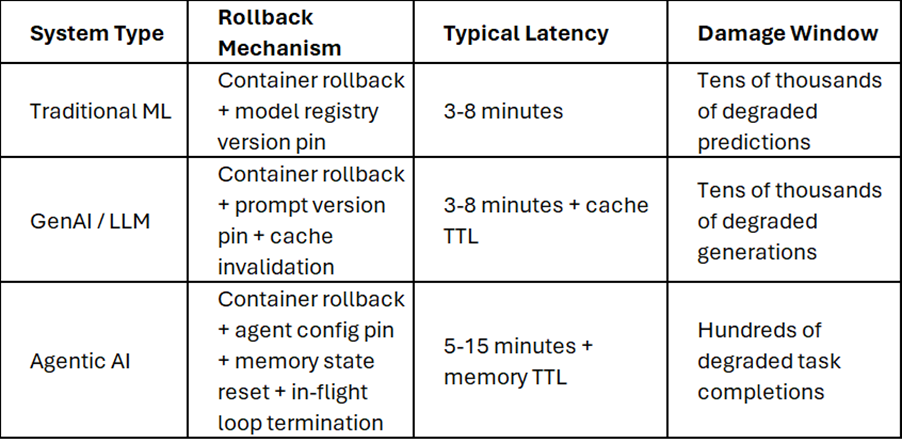
Test your rollback procedures before you need them. Run a rollback drill during shadow mode.
- Verify that the rollback completes within the expected latency.
- Verify that caches are invalidated.
- Verify that in-flight requests are handled gracefully.
A rollback procedure that has never been tested is not a safety net; it is a hope.
6. The Cost of Deployment: Parallel Infrastructure and Hold Times
The four-stage rollout funnel requires parallel infrastructure, and each stage has a cost.
Infrastructure cost drivers:
- Shadow deployment: Typically mirrors 100% of traffic in the default configuration but can be sampled to 10–25% for cost control.
- Canary deployment: Requires 1-5% live traffic. May require additional inference capacity.
- Percentage deployment: Requires 10-50% live traffic. May require additional inference capacity.
- Hold times: Each stage must be held for 24-72 hours depending on volume. The longer the hold, the higher the infrastructure cost.
The cost trade is real. The question is not whether to invest in safe deployment; the question is how to balance the cost of parallel infrastructure against the cost of a production incident.
Cost optimization strategies:
- Shadow on sampled traffic. If full mirrored traffic is too expensive, shadow on a representative sample.
- Canary on tier-stratified traffic. If 5% live traffic is too expensive, canary on a specific user tier.
- Automated promotion. Reduce hold times by automating promotion gates. When the gate passes, promote immediately.
- Reuse infrastructure. Use the same infrastructure for shadow and canary where possible. Use blue-green deployment to minimize parallel infrastructure.
The cost of safe deployment is always lower than the cost of a production incident. A rollback that takes 3-8 minutes may cost tens of thousands of degraded interactions. A production incident that affects all users may cost millions. The investment in safe deployment is an insurance policy.
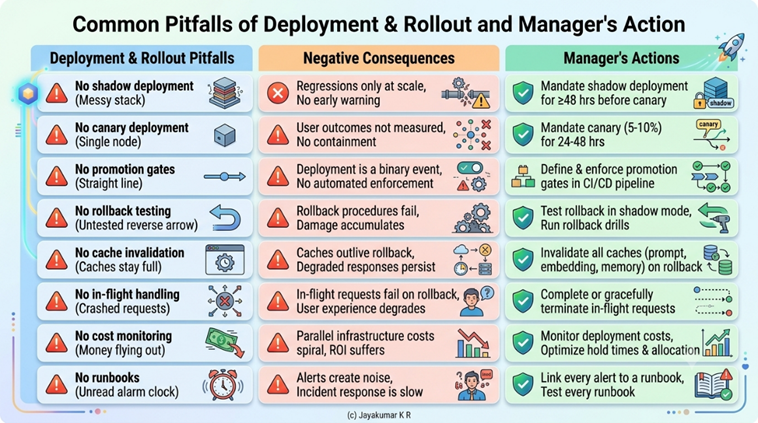
Common Pitfalls: A Manager’s Deployment Red Flag Brief
References
- FutureAGI. (2026). LLM Eval with Shadow Traffic and Canary Deployment in 2026. (“LLM Eval with Shadow Traffic and Canary Deployment in 2026”)
- FutureAGI. (2026). Agent Rollout Strategies in 2026: The Four-Stage Gate.
- LaunchDarkly. (2026). Why AI Model Deployments Break Standard CI/CD.
- CNCF. (2026, August 12). Advancing AI model interoperability with Docker and ModelPack.
https://www.cncf.io/blog/2026/08/12/advancing-ai-model-interoperability-with-docker-and-modelpack/ - KitOps. (2026). Securing Your AI Supply Chain with KitOps.
https://kitops.org/docs/security/ - Cloud Native Computing Foundation. (2025, August 27). How OCI artifacts will drive future AI use cases. https://www.cncf.io/blog/2025/08/27/how-oci-artifacts-will-drive-future-ai-use-cases/
- Yuan, J., Li, H., Ding, X., et al. (2025). “Understanding and mitigating numerical sources of nondeterminism in LLM inference.” (“Understanding and Mitigating Numerical Sources of Nondeterminism in LLM …”) NeurIPS 2025.
- Red Hat Developer. (2025). One model is not enough, too many models is hard: Technical deep dive.
- ZenML Blog. (2025, December 20). Airflow vs Kubeflow vs ZenML: Feature-by-feature comparison for modern ML teams.
- KitOps. (2026). KitOps: Standards-based packaging & versioning for AI/ML projects.
- Kubernetes. (2025). Kubernetes v1.33: New features in DRA.
- Cheng, K., Hu, W., Wang, Z., Peng, H., Li, J., & Zhang, S. (2024). Slice-Level Scheduling for High-Throughput and Load-Balanced LLM Serving. arXiv:2406.13511.
- Hellert, T., Montenegro, J., & Sulc, A. (2025). Osprey: A scalable framework for the orchestration of agentic systems. arXiv:2508.15066.
- Forbes. (2025). AWS re:Invent 2025: How AI agents make enterprise automation scalable.
All trademarks, logos, and brand names mentioned are property of their respective owners. References are for identification, commentary, or education only. No endorsement or affiliation is implied.
© 2026, Jayakumar K R. All rights reserved.
This article and all its contents, whether in this form or any other form, format, or media shall not be copied, reproduced, distributed, adapted, translated, or quoted in whole or in part without the prior explicit written permission of the author. Unauthorized use, sharing, or reproduction of this material is strictly prohibited.