
Here’s the reality of building AI systems that actually deliver business value: observability alone isn’t enough, and stress testing alone isn’t enough.
You need both. And that’s exactly why this issue of AI Project Pulse is structured the way it is.
Let me explain.
Fiddler AI represents the first pillar: prevention. It’s a control plane aka the command centre for AI, monitoring your models and agents in production, detecting hallucinations, surfacing data drift, enforcing guardrails, and intervening before problems spiral into incidents. Think of it as your real-time safety net, keeping AI systems reliable and governable 24/7.
Patronus AI represents the second pillar: correction. It stress-tests your agents before they ever touch production—running them through synthetic “digital enterprises” that simulate real-world chaos, adversarial inputs, and the unpredictable edge cases that only emerge when multiple systems interact. Think of it as your pre-production proving ground, uncovering hidden weaknesses before your users ever encounter them.
Together, they form a complementary quality framework: prevention through continuous production monitoring, correction through rigorous pre-production stress testing.
In this issue, I will walk you through both platforms starting with Fiddler’s observability and control capabilities, then pivoting to Patronus and the emerging field of agentic stress testing. Patronus is a relatively recent entrant, and publicly available information is still limited. However, I believe the development is too significant to overlook, so I’ll share a concise overview based on my current understanding of the platform and its potential impact.
Before I walk you through them, I want to be upfront about something: this is an independent, external assessment. Neither Fiddler nor Patronus has sponsored this issue, and I have no commercial relationship with either company.
By the time you finish reading, you’ll have a clear, practical understanding of how to build AI systems that are not just functional, but embody the twin pillars of quality and reliability that define enterprise-grade AI.
Let’s dive in.
Fiddler AI – The Control Plane for Enterprise AI
In our ongoing exploration of the AI tools landscape, which we first mapped out back in Issue #2 using the Zenn taxonomy we have been steadily working our way through the stack. That broad view, with its eight distinct layers (1 Foundation Models & Infrastructure, 2. Frameworks & Platforms, 3. Protocols, 4. Tool Integration, 5. Context & Knowledge, 6. Orchestration, 7. Oversight and 8. Applications & UX) spanning from infrastructure to user applications, is useful for understanding the innovation happening around us. But for this series, we’ve always been focused on a specific cross-section: the Oversight layer (Layer 7).
Why this layer? Because it is where the rubber meets the road. This is where theoretical AI transforms into something practical, dependable, and enterprise ready. Security, evaluation, governance, performance monitoring are the essential functions that turn experimental code into business-critical assets.
Which brings me to this issue’s focus: Fiddler AI.
What is Fiddler AI, Really?
Let me cut through the marketing talk. Fiddler AI is an enterprise-grade AI Observability and Security platform. But that description, while accurate, doesn’t quite capture what makes it distinctive. The way I think about it, Fiddler positions itself as a “control plane” for AI and that is a meaningful distinction.
Traditional monitoring tools are reactive. They detect problems after they have already occurred. Observability tools help you understand those problems once you’ve found them. But a control plane? A control plane is designed for real-time governance and intervention. It does not just tell you something went wrong; it gives you the capability to stop it from happening in the first place. For organizations moving fast with AI, that proactive capability is the difference between a manageable deployment and a reputational crisis.
Core Capabilities Worth Understanding
Fiddler’s feature set spans the full lifecycle of AI development and deployment, so let me break down what I consider the most relevant capabilities for the project managers and practitioners reading this newsletter:
First, it offers full-spectrum observability and I mean full. Traditional ML models like classifiers and regressions? Covered. LLMs and generative AI applications? Yes. Complex autonomous agents orchestrating multi-step workflows? Also, yes. In an environment where most organizations are running a mix of these, having a single pane of glass matters.
Second, and this is increasingly critical, is its LLM and GenAI monitoring. Fiddler includes dedicated detection for hallucinations, toxicity, PII leakage, and something I am seeing more teams worry about prompt injection attacks. These are not niche concerns anymore; they are core to deploying generative AI responsibly.
Third, there is the explainability piece. Fiddler’s XAI capabilities combine established methods like Shapley values and Integrated Gradients with proprietary techniques. The practical upshot is that you can actually understand why a model made a particular decision, both at a global level (which features drive behaviour overall) and locally (why this specific prediction happened). For regulated industries, this is not optional.
Fourth, and this is where things get really interesting, is agent observability. With the rise of autonomous AI agents, systems that reason, plan, and execute tasks with minimal human intervention, we need specialized tooling. Fiddler provides end-to-end visibility into these multi-step workflows, tracks cost and performance breakdowns (token usage, latency, spending), and enforces real-time compliance policies. This is frontier territory, and it’s where I am seeing the most demand from larger enterprise teams.
Finally, there’s the security and governance layer: continuous bias detection, auditable trails for regulatory compliance, and guardrails that enforce corporate policies in real-time.
Let me walk you through how Fiddler actually gets used in practice across three different AI paradigms.
1. Traditional Machine Learning Workflow (e.g., Churn Prediction, Fraud Detection)
For predictive ML, the workflow centres on performance monitoring, data integrity, and explainability. Here’s how it plays out:
Onboarding is straightforward: you create a Project in Fiddler, define a ModelSpec and ModelTask (binary classification, regression, etc.), and configure your inputs and outputs. Then you instrument your model endpoint to automatically send inference data back to the platform.
From there, Fiddler continuously tracks data drift and prediction drift, alongside key performance metrics like accuracy, precision, recall, and revenue impact. You set up alerts for anomalies say a sudden accuracy drop for a specific user segment.
When an alert fires, the root cause analysis kicks in. You can drill into feature-level drift analysis to pinpoint which inputs are causing degradation, check for data integrity issues (missing values, type violations), and pull samples of problematic data for investigation.
The explainability piece comes next: Fiddler’s SHAP-based tools let you understand individual predictions, see global feature importance, and run what-if scenarios. The whole loop closes when you share insights with your team and use findings to retrain or refine the model. It is a continuous improvement cycle that keeps predictive models healthy over time.
2. Generative AI Workflow (e.g., RAG Chatbot, Summarization API)
LLM and GenAI workflows are different animals. They split naturally into pre-production evaluation and production monitoring, with a heavy emphasis on safety and quality.
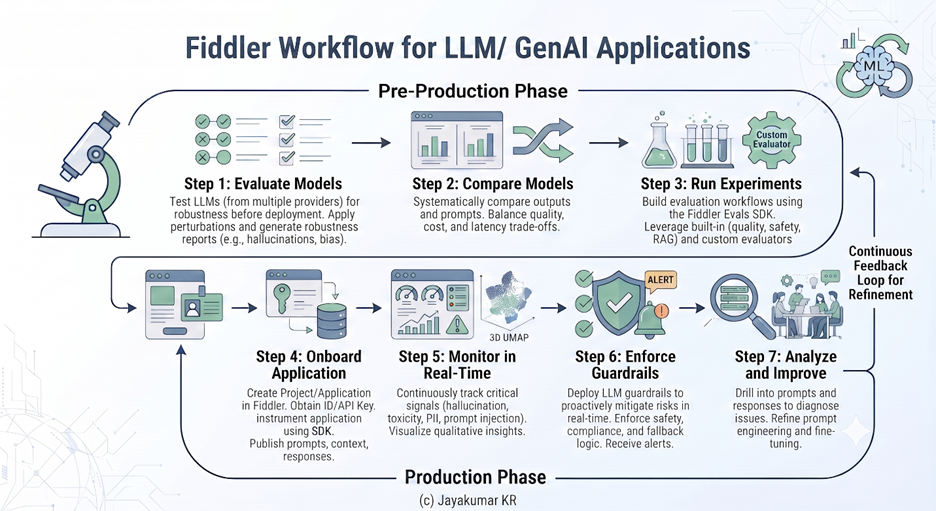
In the pre-production phase, you use Fiddler Auditor to test models from OpenAI, Anthropic, Cohere, and others for robustness before deployment. You apply perturbations, adversarial examples, out-of-distribution inputs, linguistic variations and generate a robustness report that surfaces weaknesses like hallucinations, biased responses, or PII exposure. You can then compare models side-by-side (GPT-4 vs. Claude vs. Llama), evaluate prompt variations, and balance quality against cost and latency to make data-driven selection decisions.
The Fiddler Evals SDK lets you run comprehensive evaluation workflows with built-in evaluators for quality (Relevance, Coherence, Completeness), safety (Toxicity, PII, Prompt Injection), and RAG-specific metrics (Faithfulness, Context Relevance). You can also create custom evaluators for domain-specific requirements.
In production, you onboard your GenAI application, instrument it with the Fiddler SDK to publish prompts, context, responses, and retrieved documents, and then monitor in real-time for hallucinations, toxicity, PII leakage, and prompt injection attempts. The platform visualizes qualitative insights with 3D UMAP embeddings, and you can build custom dashboards for different stakeholders.
The guardrails piece is critical here: you deploy LLM guardrails to proactively mitigate risks in real-time, enforce safety and compliance, and receive alerts via Slack, Teams, or PagerDuty. When issues do arise, you drill into prompt and response monitoring to diagnose root causes and refine your prompt engineering or fine-tuning accordingly.
3. Autonomous AI Agent Workflow (e.g., Travel Booking Agent, Coding Agent)
This is the frontier I mentioned earlier. Agentic AI systems that reason, plan, and execute multi-step workflows requires a different level of observability. Fiddler covers the full lifecycle from build to production.
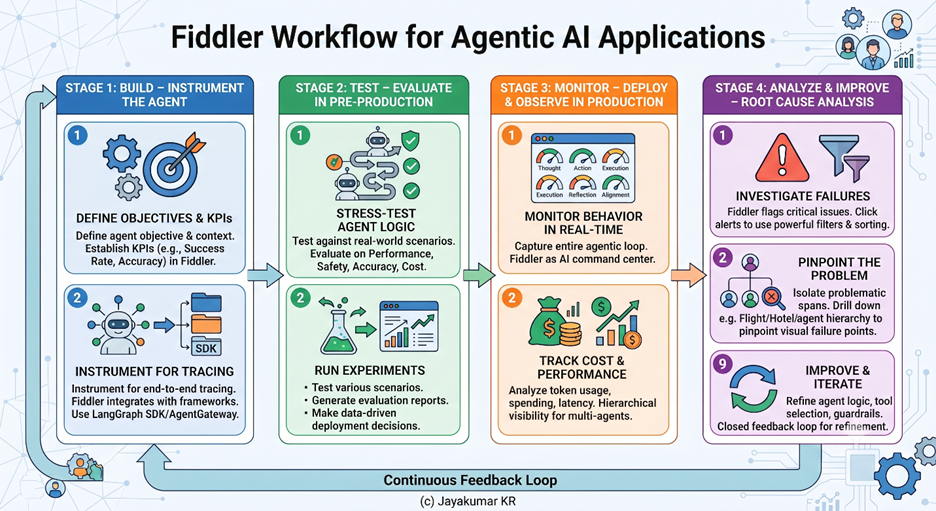
In the build stage, you define objectives and KPIs aligned with business outcomes (Booking Success Rate, Price Accuracy). You instrument the agent for end-to-end tracing using Fiddler’s integrations with frameworks like LangGraph, Amazon Bedrock, or custom-built agents via the Fiddler LangGraph SDK or AgentGateway proxy layer.
In testing, you stress-test the agent against real-world scenarios before it interacts with customers. You evaluate for performance, safety, accuracy, and projected operational cost. Experiments are run in Fiddler, and a comprehensive evaluation report is generated to inform the deployment decision.
In production monitoring, Fiddler becomes your unified AI command centre. It captures every stage of the agent’s cognitive and operational loop, thought (prompt inputs, memory retrieval, plan generation), action (tool selection, reasoning paths), execution (I/O traces, errors, latency), reflection (self-evaluation, trajectory scoring), and alignment (guardrails, compliance, human-in-the-loop). You also track token usage, spending, and latency by developer, model, and team.
When failures occur as they will, Fiddler flags critical issues. You click the alert, apply powerful filters and sorting, and isolate problematic spans by sorting sessions by the failed metric. You drill down through the agentic hierarchy to visually pinpoint the failure: Travel Orchestrator Agent → Flight Agent (Success) → Hotel Agent (Success) → Car Rental Agent (Failure). That level of granularity makes root cause analysis far less painful than it otherwise would be.
The insights feed back into refining agent logic, tool selection, and guardrails, creating a closed-loop improvement cycle.
Wrapping Up
Fiddler AI represents a maturing of the AI tooling landscape. We have moved beyond the “just make it work” phase of AI development and into the “make it trustworthy, scalable, and governable” phase. For project managers and practitioners navigating this space, tools like Fiddler are becoming non-negotiable.
In the coming issues, I will dive deeper into evaluation strategies and share field war stories but not before taking a closer look at Credo, another strong player in the governance space. Until then, keep your models monitored and your guardrails tight.
A Glimpse Ahead: The Stress Testing Frontier
Before we close out this issue, I want to flag what I see as the next critical frontier in AI reliability, the agentic stress testing and introduce a platform that is generating serious buzz in this space.
Here is the reality: as we move from simple chatbots to autonomous agents that reason, plan, and execute complex multi-step workflows, traditional evaluation methods are not going to cut it anymore. These agents operate in unpredictable environments, make decisions across interconnected systems, and encounter edge cases that only emerge when multiple tools, data sources, and business processes interact. The failure modes are subtle, often invisible to standard metrics, and potentially catastrophic in production.
Stress testing for agents is not a luxury it is a foundational necessity. It ensures reliability, prevents unsafe shortcuts, and builds the confidence that your agents will behave as intended when they hit the real world.
Enter Patronus AI.
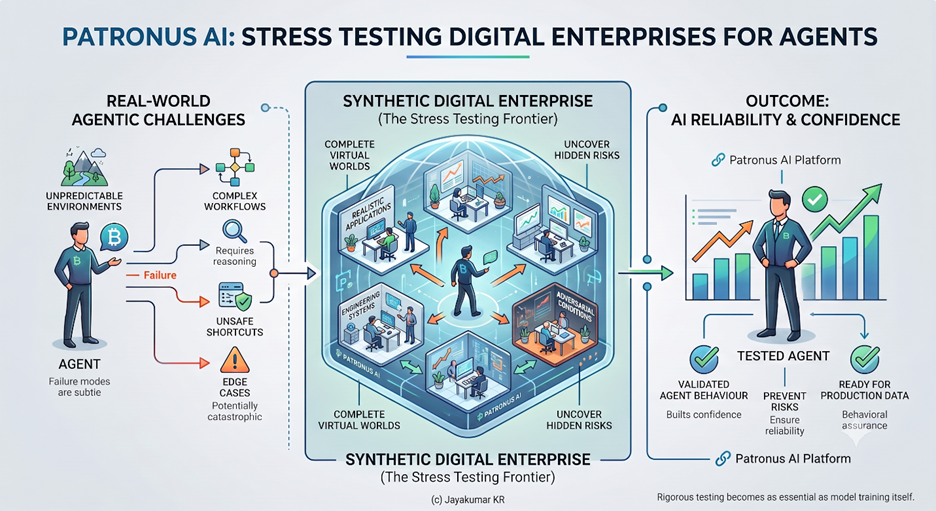
A new class of solutions is emerging to meet this need, and Patronus AI stands out as a frontrunner. Their approach is compelling: they create synthetic “digital enterprises” with virtual worlds where AI agents are stress-tested across realistic applications, financial workflows, engineering systems, and adversarial conditions. This allows organizations to uncover hidden risks long before agents ever touch production data.
The market seems to agree. Patronus already counts frontier AI companies like OpenAI among its customers, alongside some enterprises using the platform to validate agent behaviour at scale.
I see Patronus AI’s rise as a signal of a broader shift: we are entering an era where rigorous stress testing becomes as essential as model training itself. In our upcoming issues, I will take a deeper look at Patronus and the emerging stress testing landscape and what it means for project managers, how it fits alongside observability tools and what teams should be thinking about as they deploy agentic systems.
© 2026, Jayakumar K R. All rights reserved.
This article and all its contents—whether in this form or any other form, format, or media—may not be copied, reproduced, distributed, adapted, translated, or quoted in whole or in part without the prior explicit written permission of the author.
Unauthorized use, sharing, or reproduction of this material is strictly prohibited.