
Abstract
In this edition of AI Project Pulse, a seasoned leader driving the evolution of Quality Assurance in the age of Generative AI, applies our AI Project Typology framework to the ground realities of the IT services industry. The article examines how AI applications in this sector fall into two distinct buckets: client-facing innovations and internal productivity enablers. It explores why, despite rapid AI model advancement, the industry’s growth remains measured driven by client concerns around reliability, ROI, and evolving regulations. The piece also offers a reality check on productivity claims, contrasting vendor hype around coding efficiency with the practical constraints of brownfield implementations and legacy systems. Concluding with a grounded outlook on AI Agents, this analysis provides essential perspective for anyone navigating AI delivery in the IT services landscape.
In the first issue of AI Project Pulse, we introduced a foundational framework: the AI Project Typology. This model was designed to bring clarity to the chaotic world of AI initiatives by classifying them into five distinct types—from the incremental optimizations of Incremental Innovation and the market-creating ambition of Disruptive Innovation to the foundational work of Applied Research, the internal scalability of AI Enablers, and the grassroots potential of Citizen-Led Innovation.
This framework is not just an academic exercise; it is a lens through which we can diagnose the real-world challenges facing different sectors. Today, we apply that lens to the IT services industry, a sector uniquely positioned at the intersection of building AI for others and using AI to build itself.
To provide this analysis, we turn to a voice of profound experience. Vishnu Varthanan Moorthy, Senior Director, Quality at Capgemini Technology Services India Limited, brings a deep practitioner’s background and a wide-angle view of the global IT services landscape. As a leader driving the evolution of Quality Assurance in the age of Generative AI, Vishnu has been at the forefront of mapping GenAI’s impact across the software development life cycle (SDLC), collaborating with subject matter experts to eliminate adoption barriers. His current roadmap prioritizes the dual pillars of GenAI: maximizing delivery productivity and ensuring rigorous compliance through advanced governance frameworks. His perspective helps us understand why, despite the rapid advancement of AI models, the industry’s growth tells a more measured story.
Here is what Vishnu says about how AI Project Typology Meets the Ground Truth of the IT Services Market:
For IT service organizations, AI applications primarily fall into two broad groups. The first is delivering AI-based products and services to clients. The second is applying AI as an enabler to improve internal productivity and service delivery efficiency.
AI-based products and services delivered to clients can be further categorized into Incremental Innovation and Disruptive Innovation, depending on the value delivered and the speed at which clients realize benefits. The purpose and source of such innovation typically span Applied Research and Citizen-Led Innovation, often emerging from the broader technology community.
However, the IT services industry has not experienced growth at the same dramatic pace as the rapid advancement of AI models themselves. This gap between model evolution and real-world application is also reflected in current trends, where the share prices of several large IT companies have continued to decline.
While some organizations, particularly in non-regulated industries have begun adopting AI-based products, a large segment of the market remains cautious. This apprehension is driven by several factors:
- Concerns around the reliability of AI outcomes and the expectations of Responsible AI
- Global market conditions and uncertainty around expenditure on AI-driven capability additions
- Unclear ROI on AI investments
- Evolving compliance requirements, such as the EU AI Act, sustainability mandates, and related regulations
As a result, cautious and incremental steps continue to dominate market adoption. Ideally, AI should create a business leap similar to the acceleration of digital transformation during the COVID period, when customers were compelled to move to digital channels rapidly. In the same way, AI has the potential to drive significant business uplift and cost reduction for customers. However, its fitment across all areas and complete reliance on AI-driven outcomes has not yet been achieved. Unlike traditional computing systems that deliver deterministic mathematical or logical results, AI outcomes are often subjective, variable, and difficult to explain, which contributes to the prevailing wait-and-watch approach.
When it comes to AI as an enabler in IT service delivery, customer expectations are much clearer. Clients increasingly expect IT service organizations to reduce operational costs and pass on the benefits in the form of lower contract prices or commercial credits. This trend is now evident across most new contracts, irrespective of industry. Many organizations assume a set of use cases where AI-assisted development and operations will contribute to efficiency gains. At present, most customers anticipate a 5% to 20% cost impact from such initiatives.
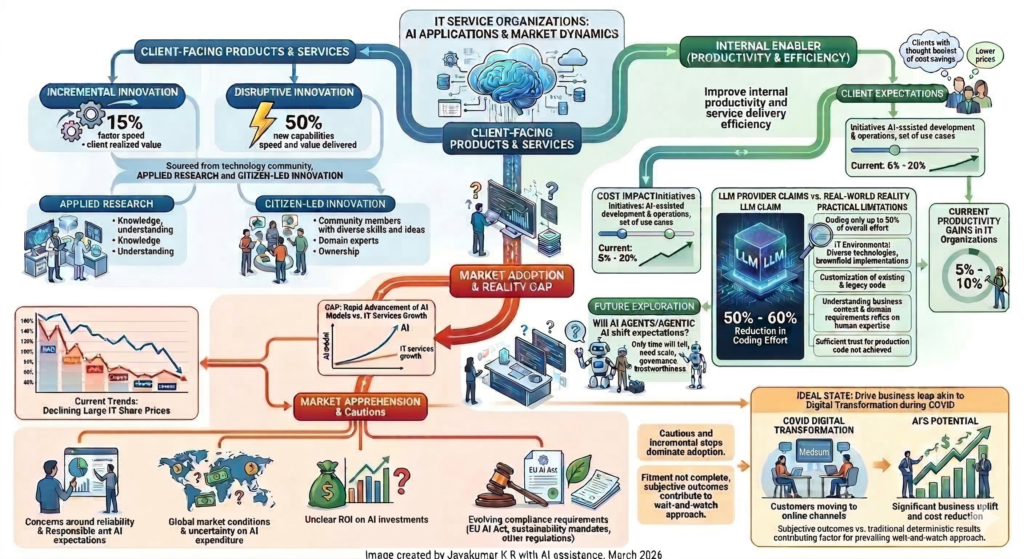
However, market claims, particularly from LLM providers suggesting 50% to 60% reduction in coding effort are not straightforward to realize in practice. In a typical software development lifecycle, coding itself accounts for only up to 50% of the overall effort. Additionally, IT environments are characterized by diverse technologies and, more often than not, brownfield implementations rather than greenfield development. These scenarios require customization of existing systems and legacy code, where AI assistance has inherent limitations.
Moreover, understanding business context and domain requirements remains more critical than coding itself and continues to rely heavily on human expertise. In situations where AI systems are expected to read, modify, or deploy production code, customers do not yet have sufficient trust in the current levels of AI reliability. Consequently, in practical terms, overall productivity gains in IT service organizations are typically limited to 5% to 10% in today’s context.
Will AI Agents or Agentic AI fundamentally change this equation? Possibly, but only time will tell. These approaches still need to demonstrate consistent reliability, governance readiness, and trustworthiness at scale before they can materially shift productivity expectations.
© 2026, Jayakumar K R. All rights reserved.
This article and all its contents—whether in this form or any other form, format, or media—may not be copied, reproduced, distributed, adapted, translated, or quoted in whole or in part without the prior explicit written permission of the author.
Unauthorized use, sharing, or reproduction of this material is strictly prohibited.