
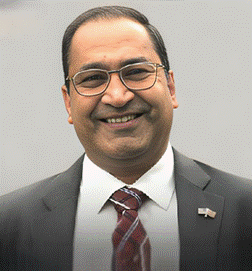
Ravindra Barlingay
Chief Executive Officer, IITM C‑DOT Samgnya Technologies Foundation, National Hub for Quantum Communication · DST, National Quantum Mission
Ravindra Barlingay brings over three decades of leadership across technology, innovation, telecommunications, digital transformation and deep tech ecosystems. He is known for translating cutting edge research into solutions with national and global impact.
As CEO of the IITM C‑DOT Samgnya Technologies Foundation, established under India’s National Quantum Mission, he leads the creation of a collaborative ecosystem for quantum communication technologies. His work focuses on accelerating research translation, enabling industry adoption, supporting deep tech startups, developing quantum talent, establishing national testbeds and building strategic partnerships across academia, industry, government and international stakeholders.
His career spans leadership roles in business strategy, technology commercialisation, ecosystem development and institution building. He is widely recognised for bringing together diverse stakeholders to solve complex challenges and enable innovation at scale.
Ravindra believes India’s opportunity in quantum technologies lies not only in scientific excellence but in building trusted digital infrastructure, nurturing globally competitive enterprises and strengthening indigenous capabilities for long term technological resilience.
Q1 The Rise of the Intelligence Economy
Jayakumar: Many still view AI as just another digital technology. But you describe a much deeper shift the emergence of an Intelligence Economy. What makes this transition so historic?
Ravindra Barlingay: We are witnessing a transition as significant as the Industrial Revolution or the emergence of the internet. For the first time in history, intelligence itself is becoming an economic resource. Until now, intelligence existed only within human beings. Today it is programmable, distributable, scalable and continuously improving. This changes not only business but economics, governance, manufacturing, healthcare, BFSI and society itself.
Q2 Building the Ecosystem for an Intelligence‑Driven Future
Jayakumar: Every major economic shift needs an ecosystem to support it. What does the ecosystem of the Intelligence Economy look like?
Ravindra Barlingay: Every successful economy depends on more than a single resource it depends on an ecosystem that converts that resource into prosperity. The Intelligence Economy rests on five strategic foundations: computational capability, knowledge, autonomy, continuous learning and trust. Without trust, intelligence cannot move beyond laboratories into society.
Q3 “Data Is Not the New Oil” A Contrarian View
Jayakumar: You challenge the widely accepted idea that data is the new oil. Why do you believe this no longer holds true?
Ravindra Barlingay: Data is no longer scarce. Every enterprise, factory, mobile phone and connected device generates enormous quantities of data. The true competitive advantage lies in transforming that data into trusted decisions. Artificial Intelligence gives us that capability, but only if those decisions themselves can be trusted.
Q4 National Decision Velocity: A New Measure of Competitiveness
Jayakumar: You introduced a compelling concept National Decision Velocity. How does this redefine competitiveness for countries like India?
Ravindra Barlingay: Every government, enterprise and institution exists fundamentally to make decisions. The countries that can observe change earlier, understand it better, decide faster, execute effectively and continuously learn from the outcomes will consistently outperform those that cannot. In the twenty‑first century, national competitiveness will increasingly depend upon how intelligently a nation learns and adapts.
Q5 Quantum Communication and the Infrastructure of Trust
Jayakumar: You argue that quantum communication is not just a cybersecurity tool but part of the trust infrastructure of the Intelligence Economy. Could you expand on that?
Ravindra Barlingay: Intelligence without trust eventually becomes a liability. As AI becomes embedded into manufacturing, healthcare, transportation, finance and critical infrastructure, the integrity of the communication network becomes just as important as the intelligence of the algorithm itself. Quantum communication is part of the trust infrastructure of the Intelligence Economy. Tomorrow’s economy will depend not only upon intelligent machines but upon trusted identities, trusted communication, trusted data and trusted decisions. Responsible AI must include resilience, cybersecurity and quantum safe communication. Without trust, intelligence cannot scale.
Q6 India’s Opportunity: Convergence of National Missions
Jayakumar: India seems to be at a unique moment where multiple national missions are converging. How does this shape our potential in the Intelligence Economy?
Ravindra Barlingay: India has a remarkable opportunity because multiple national missions are now converging. Digital Public Infrastructure, the IndiaAI Mission, the Semiconductor Mission, the National Quantum Mission, advanced manufacturing initiatives and one of the world’s largest engineering talent pools together provide the foundations of an Intelligence Economy. Our challenge is no longer capability. Our challenge is integration. We must stop thinking in silos and begin building a national architecture where research, industry, policy and technology reinforce one another.
Q7 Tamil Nadu: A State Poised for Leadership
Jayakumar: Tamil Nadu has been emerging as a strong technology and manufacturing hub. How do you see its role in this new era?
Ravindra Barlingay: Tamil Nadu is particularly well positioned to lead this transformation. The state combines world class manufacturing, automotive leadership, electronics, a vibrant startup ecosystem, IIT Madras, the Research Park and the National Hub for Quantum Communication. These are not isolated strengths. Together they form the foundation of an intelligent industrial ecosystem. Tamil Nadu therefore has the opportunity not merely to become an AI hub but to become one of the world’s first demonstrations of a trusted Intelligence Economy.
Q8 Leadership Beyond Survival
Jayakumar: If we return to the original question can India survive without AI how would you frame the answer today?
Ravindra Barlingay: Yes, India can survive without Artificial Intelligence. But survival has never been India’s ambition. Our ambition has always been leadership. Leadership in the twenty‑first century will belong to nations that build intelligence responsibly, secure it through trust, integrate it across society and continuously use it to improve the lives of their citizens. India possesses every ingredient necessary to achieve that vision. The opportunity before us is not simply to adopt AI; it is to define the future of the Intelligence Economy.
Q9 About the National Hub for Quantum Communication
Jayakumar: Throughout this conversation you have emphasised that trust is the backbone of the Intelligence Economy, and that without trusted identities, communication, data and decisions, intelligence simply cannot scale. Given this, could you tell our readers how your organisation, the National Hub for Quantum Communication, contributes to strengthening the trust infrastructure for AI and enhancing India’s National Decision Velocity?
Ravindra Barlingay: Thank you this is a question close to our mandate. The National Hub for Quantum Communication exists precisely to build the trust layer on which an Intelligence Economy depends. I would describe our contribution along four dimensions.
First, quantum safe communication. We advance quantum secure communication for national data networks deploying scalable Quantum Key Distribution (QKD) infrastructure and enabling the country’s transition to post quantum cryptography (PQC). This is the foundation on which trusted identities, trusted communication, trusted data and trusted decisions can rest.
Second, testing, validation and standards. As an accredited testing laboratory, we evaluate quantum communication technologies against rigorous benchmarks and support the development of national standards, working alongside the country’s standards and certification bodies. Independent, credible testing is what allows industry and government to adopt these technologies with confidence.
Third, startups and industry collaboration. We support deep tech startups building next generation quantum communication solutions, and we foster the industry partnerships that carry research from the laboratory into deployment at national scale.
Fourth, talent and capacity building. We develop future ready quantum talent through specialised training, research programmes and industry collaboration, offering intern, fellow and research associate opportunities to nurture the next generation of quantum professionals.
Taken together, these strengthen India’s National Decision Velocity. When the channels through which decisions flow are secure, tamper resistant and future ready, institutions can observe, decide and act with confidence. AI provides the intelligence; quantum communication provides the trust. That is the contribution we are committed to making not only for India, but as a demonstration of how trusted intelligence can be built, scaled and governed.