
For project leaders, experiment tracking is not a data scientist’s chore; it is the foundational governance infrastructure that determines whether AI investments yield predictable returns or dissolve into irreproducible chaos.
Experiment Tracking and Management is the systematic discipline of capturing, organizing, governing, and evaluating every iteration of an AI system, from the initial data sample to the production deployment. It transforms a messy, ad-hoc research process into a structured, auditable workflow.
Unlike deterministic code, AI outcomes depend on a volatile mix of data versions, hyperparameters, environments, prompts, and agent trajectories. Without management, you cannot answer: “Why did this version perform better, and can we prove it to regulators?”
The Four Pillars:
- Risk Reduction: No reproducibility = no rollback capability. Audit trails are non-negotiable.
- Cost Control: Without tracking, teams waste GPU/LLM budgets on forgotten experiments and over-engineered models.
- Team Coordination: A single source of truth aligns data engineers, ML researchers, prompt engineers, and compliance.
- Regulatory Compliance: The EU AI Act demands proof of due diligence in model selection and validation.
Without systematic tracking, teams lose reproducibility. What worked in 2020 is insufficient for 2026’s governance demands. This investigation builds on Investigation 3’s validation techniques, translating why to validate into how to ensure every validation is reproducible, auditable, and improvable, ensuring business accountability.
Experiment tracking is now a non-negotiable foundation. Three dimensions impact project management:
- Scope expansion (From Numbers to Business Logic): From tracking hyperparameters and numbers to tracking prompts, traces, feedback, and agent trajectories giving management visibility into the quality of the decision-making process, not just the final output.
- Integration depth (From Notebooks to CI/CD): From standalone tracking to Continuous Integration/ Continuous Delivery/ Deployment (CI/CD) integrated governance with automated quality gates enabling management to enforce compliance and quality without becoming a bottleneck.
- Scale requirements (From Solo to Enterprise): From individual researcher notebooks to enterprise-scale observability with role-based access control and lineage, allowing management to delegate permissions securely and track project costs across multiple teams.
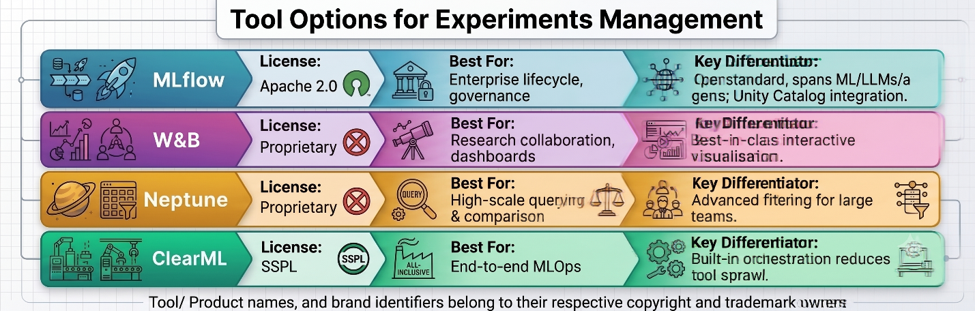
MLflow is the industry standard, trusted by thousands of organizations. Systematic tracking is now mandatory for mature AI programs.
Traditional ML Experiment Tracking
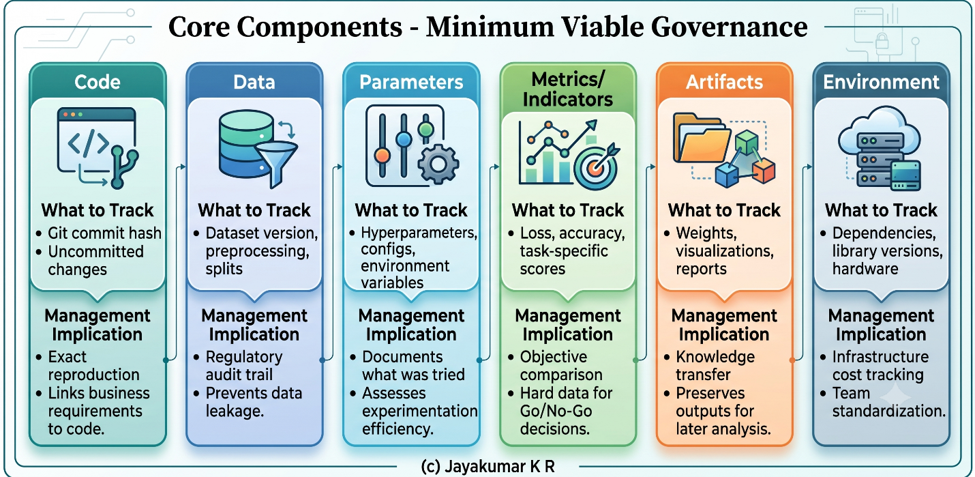
Core Components (Minimum Viable Governance)
Tool Options
GenAI-Specific Tracking
GenAI introduces artifacts traditional tracking never captured. Since MLflow 3.0, the platform supports prompt versioning, agent tracing, and custom judges, bringing visibility and control to the black-box realm of LLMs.
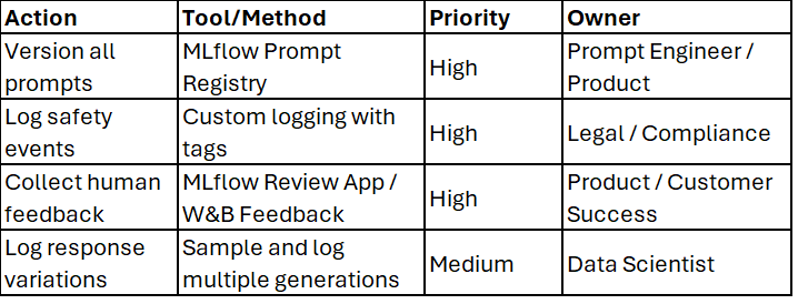
Prompt Versioning (Managing IP)
Small prompt changes cause unexpected behaviour and cost spikes. Without versioning, regressions are untraceable.
Version prompts with safe rollback, gradual rollout, and automatic performance tracking like managing an API contract.
MLflow Prompt Registry provides Semantic versioning, Lineage between prompts and application versions (auditable by legal), Automatic linking to experiments, and Prompt search within experiments.
Pin model and prompt versions in production. Re-run evaluations before any change. Treat prompts as product assets.
Response Variation Catalogues (Quality Consistency)
Non-deterministic outputs require:
- Response sampling (multiple generations per input)
- Variation indicators (diversity, consistency tolerance)
- Failure pattern catalogues (hallucinations, refusals, off topic)
Safety Flag Logs (Risk & Compliance)
Safety and moderation events must be tracked with:
- Trigger context: What input or output triggered the safety flag.
- Action taken: Whether the response was blocked, modified, or allowed with warning.
- Review status: Whether human review occurred and its outcome.
Safety flags should be integrated into the experiment tracking system as first-class artifacts, not afterthoughts logged separately. This provides the legal team with a defensible record of moderation actions.
Feedback Collection (Closing the Loop)
Human feedback is essential for GenAI improvement. MLflow now provides a no-code review app (MLflow Review App) to collect user feedback. This enables:
- Expert feedback on model outputs.
- Annotation collection for fine-tuning data.
- Feedback-driven improvement cycles.
For management, this bridges the gap between the development team and the business stakeholders (customer support, legal, product managers), allowing them to contribute directly to the tuning process.
Agentic Tracking (Managing Autonomous Systems)
An agent’s behaviour is temporal, contextual, and interactive failures often emerge only after sequences of decisions unfold, not in individual outputs. For project managers, debugging these failures without proper tracking is nearly impossible.
Action Trajectory Mapping (Understanding Process, not just Output)
LLM agents produce rich, multi-step trajectories that interleave observations, internal reasoning, and tool actions. However, most evaluation pipelines focus solely on end-task success, leaving the agent’s decision-making process opaque and poorly understood. (“AgentDiagnose: An Open Toolkit for Diagnosing LLM Agent Trajectories”)
Track the complete trajectory including every observation, reasoning step, tool call, and state transition.
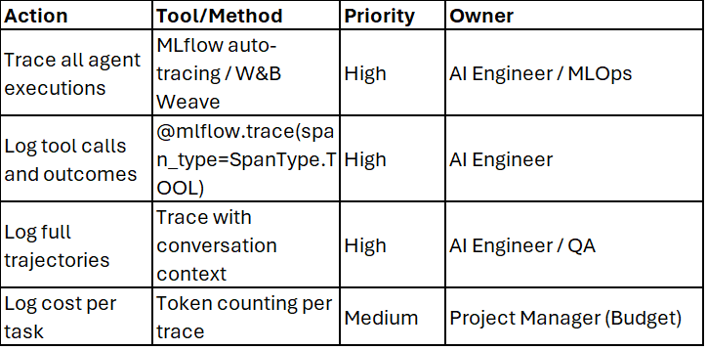
MLflow provides comprehensive agent tracing:
- Auto-tracing for OpenAI, Anthropic, LangChain, LangGraph, LlamaIndex, AutoGen, and VoltAgent.
- Manual tracing via function decorators for custom instrumentation.
- OpenTelemetry-compatible tracing for agent debugging.
AgentDiagnose: An open-source, modular framework for diagnosing agent trajectories that quantifies five core agentic competencies: backtracking & exploration, task decomposition, observation reading, self-verification, and objective quality. (“AgentDiagnose: An Open Toolkit for Diagnosing LLM Agent Trajectories”) This helps management identify exactly which competency the agent is lacking, allowing for targeted process improvements.
Conversation Replay (Audit & Compliance)
Replay auditing: Re-running a production agent’s recorded execution against its own history, across different substrates, and against its own instrumentation. It enables detection of drift against the agent’s own historical behaviour. This is a vital risk management tool.
Weights & Biases Weave provides agentic observability for the full lifecycle of agent conversations, including sessions, LLM calls, and tool executions. It automatically instruments supported third-party agent harnesses such as Claude Code and OpenAI Agent SDK with no additional code.
Key Agentic Tracking Requirements:
Agent Decision Logs (The Irrefutable Record)
For agentic systems, reporting runtime traces alongside interaction logs lets readers attribute task outcomes to the right component. Agent Observability logs have become a default standard.
Pipeline Automation & CI/CD Integration
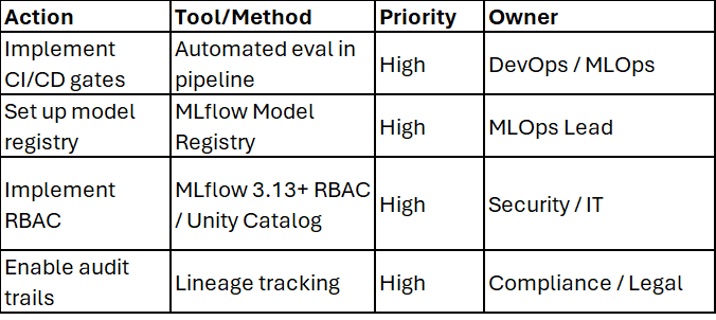
Governance must be automated. Responsible AI needs CI/CD checks, not manual reviews that bottleneck and introduce error. CI/CD pipelines for AI must include:
- Unit tests: Component-level validation.
- Integration tests: End-to-end pipeline validation.
- Performance gates: Metrics must meet thresholds (business KPIs).
- Fairness checks: Bias detection must pass (legal/ethical compliance).
- Safety checks: Guardrails must be satisfied (consumer protection).
- Rollback automation: Automatic revert if gates fail (business continuity).
Management enforces these gates to ensure that no unvalidated code ever reaches the production environment, minimizing the risk of a high-profile AI failure.
Model Registry as Governance Hub
The MLflow Model Registry serves as a centralized model repository, UI, and set of APIs for managing the model deployment process. (“MLflow on Databricks | Databricks on AWS”) It provides:
- Version tracking with staging workflow (none → staging → production → archived).
- Lineage from data through training to deployment.
- Role-based access control with roles as reusable bundles of permissions covering experiments, models, prompts, scorers, and AI Gateway endpoints.
Managed MLflow on Databricks integrates with Unity Catalog, allowing organizations to enforce access controls, track lineage across models and data, and maintain compliance policies from a central governance layer. This centralizes security and reduces administrative overhead.
CI/CD for AI Agents
EvalForge exemplifies CI/CD for agents; It proves your LLM system is faithful, safe, cheap, and ready to ship with a single PASS/FAIL, incorporating prompt-injection guardrails, trace and span observability, cost tracking, and a deploy gate.
Governance primitives (model cards, bias detection, audit trails, human escalation) allow management to define enforceable standards.
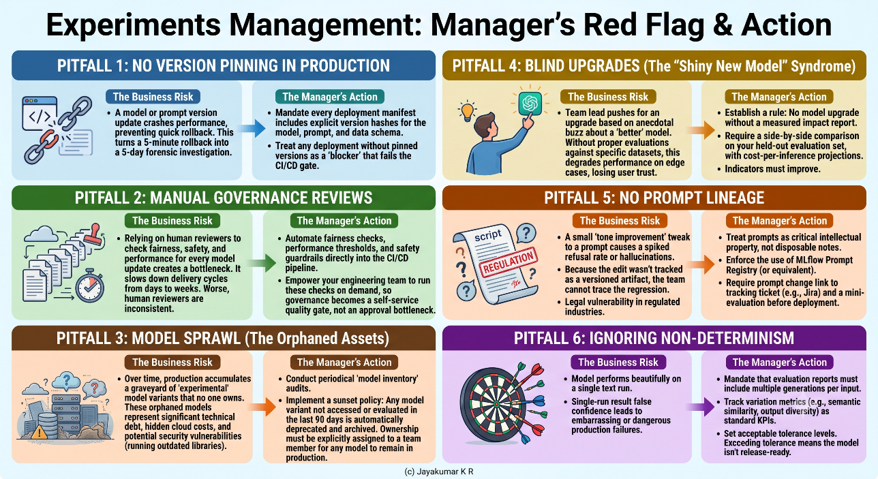
The Critical Management Principle: “If It Exists, It Must Be Versioned”
- Pin model and prompt versions in production; no unpinned artifacts.
- Re-run evaluations before any change; ensure intentional improvements, not regressions.
- Avoid model sprawl as orphaned variants = technical debt + security risk. Mandate regular audits.
- Avoid blind upgrades; Demand measured impact. Resist “shiny new model” syndrome.
Lineage: The Connective Tissue of Trust
Data Version → Feature Version → Experiment Run → Model Version → Prompt Version → Deployment
Each link must be trackable and drillable for details. When an executive asks “Why did this fail?”, lineage pinpoints root causes such as data drift, prompt change, or code bug.
Practical Implementation Guide (Project Manager’s Checklist)
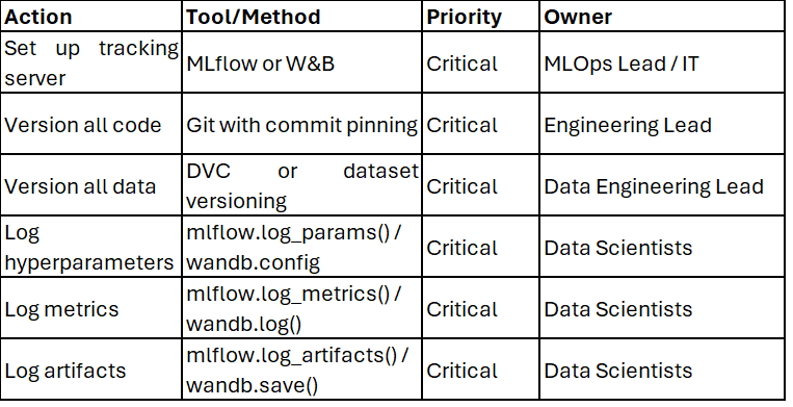
1: Establish Tracking Baseline/ Traditional ML Foundation
2: GenAI Tracking
3: Agentic Tracking
4: Automate Governance
Common Pitfalls: A Manager’s Red Flag & Action Brief
References
- BearPlex. (2026). MLflow Review (2026): Honest Assessment from BearPlex Engineers.
- Databricks. (2026). Track prompt versions alongside application versions. Azure Databricks Documentation.
- MLflow. (2025). MLflow 3.7.0 Release Notes.
- MLflow. (2026). Tracing and Evaluating OpenAI Agents. MLflow Cookbook.
- Ou, T., Guo, W., Gandhi, A., Neubig, G., & Yue, X. (2025). (“AdvPlan-Bench: Adversarial Evaluation of Structured Plan-Generation Agents”) AgentDiagnose: An Open Toolkit for Diagnosing LLM Agent Trajectories. Proceedings of EMNLP 2025: System Demonstrations, 207–215.
- Springer. (2026). MLflow 3 and the GenAI Agents. In Managing Machine Learning Lifecycles with MLflow.
- Weights & Biases. (2026). What is Weave? W&B Documentation.
- AI Wiki. (2026). MLflow.
All trademarks, logos, and brand names mentioned are property of their respective owners. References are for identification, commentary, or education only. No endorsement or affiliation is implied.
© 2026, Jayakumar K R. All rights reserved.
This article and all its contents, whether in this form or any other form, format, or media shall not be copied, reproduced, distributed, adapted, translated, or quoted in whole or in part without the prior explicit written permission of the author. Unauthorized use, sharing, or reproduction of this material is strictly prohibited.