
Once upon a time, in a boardroom not so far away, a Chief Digital Officer returned from a three-day “Digital Transformation” retreat in a seaside resort. His head was buzzing with a single, sacred word: AI-Native. He signed next a multi-million deal for an “AI-Native Supply Chain Platform” with the fervour of a man buying fire insurance. A month later, he asked the platform to predict festival demand. It suggested he order 10,000 units of “generic festive items” and, when pressed for specifics, recommended selling watermelons in December because its training data had a fruit-bias glitch.
Panicked, he called the AI product vendor. The calm sales engineer replied, “Sir, you are not using the Agentic version. That is an add-on. This is merely AI-Enhanced.”
Welcome to the great AI-fication of everything. It is the year 2026, and if a product does not have “AI” plastered on it, it might as well be a stone tablet. But as the ancient philosophy reminds us, detachment is the key to peace. When a man sees his house on fire, he panics. When he realizes he no longer owns the house, he watches the flames with a cup of chai (Read the story of ‘a life detached’). Similarly, if we detach ourselves from the marketing jargon, we might just survive the inferno of buzzwords without getting wheeled into a hospital.
The Snake Oil and the New Oil
In 2006, a data scientist told us, “Data is the new oil.” Today, Princeton’s Professor Narayanan warns us that much of AI is just “Snake Oil.” So, where does that leave the poor enterprise buyer? Stuck in a slippery zone where Big Tech skates fearlessly, businesses tread cautiously, and the rest of us just slide around confused (Read the story of AI currency between snake oil and new oil).
The industry has brewed a delightful concoction of categories to confuse the common man. Let us decode them with the grace of a lead assessor auditing heaven.
The Taxonomy of Nonsense
- AI-Enabled / AI-Enhanced: This means the vendor took their 1998 legacy software, slapped a “Generate” button on the top right, and connected it to OpenAI’s cheapest API. If you turn off the internet, the product works perfectly, minus the “Generate” button which now just spins indefinitely. Remove the AI, and the product is still there, judging you.
- AI-First: This is strategic lip service. The company thinks about AI during breakfast meetings. It is central to their PowerPoint presentations, but the underlying database is still held together by duct tape.
- AI-Native: Ah, the holy grail. This means if you remove the AI, the product literally disintegrates into a puff of smoke. There is no “off” switch because the AI is the product. As the a16z venture capitalists say, “the model is the product, not a feature.” In India, we call this Jugaad that works too well.
- Agentic AI: This is the new kid on the block. It promises to act autonomously. In reality, it means the AI will autonomously draft an email, autonomously send it to the wrong client, and autonomously schedule a meeting at 3 AM IST to apologize.
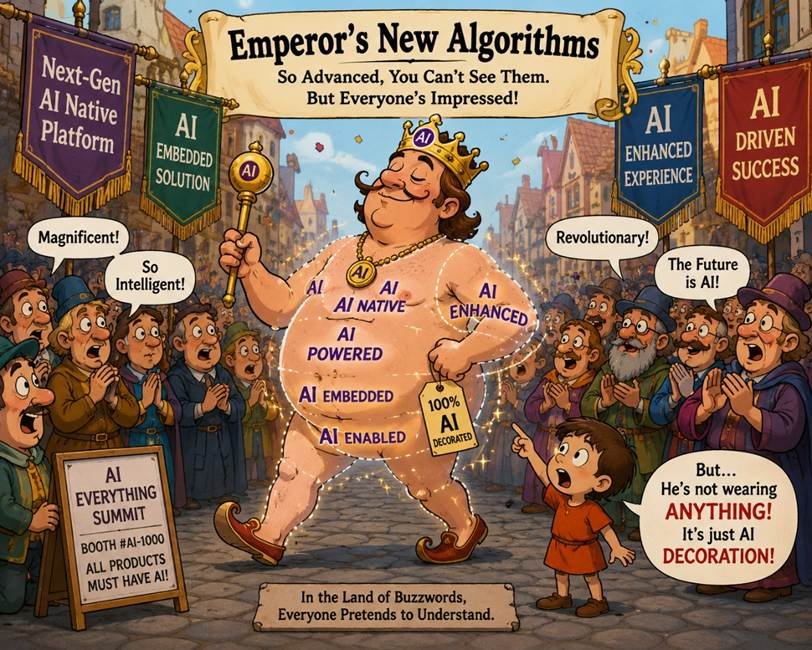
To test these claims, use the “Lead Assessor Unannounced Visit” method. Remember the story of the lead assessor who visited Hell (Read the story of ‘Audit Happens’). When Hell knew he was coming, it was a five-star party. When he landed unannounced, it was fire, fierce snakes and boiling oil. The same applies to AI demos. Ask any vendor, “Can you show me this working right now, without the demo environment, on my messy, uncleaned data?” That is when the hallucinations begin. That is your real audit, and you will discover whether the product is just ‘AI decorated’.
Absolutely Painful Illusion
In a world where nearly, every human capability is being packaged, priced, and delivered on demand, we have reached a new frontier: you can now “Order an API” for intelligence itself. What once required lived experience, mentorship, or deep study is increasingly accessed like a utility which is metered, scalable, and instantly deployable.
Consider the story of a mid-sized bank that bought an “AI-Powered” fraud detection system. The vendor claimed it was “AI-Native.” When the system flagged the CEO’s personal transaction as a potential money-laundering incident and locked his account on a Saturday night, the bank realized the AI was native only to the vendor’s bank account, not to their business logic.
The confusion arises because vendors treat “AI” like Uber treats car ownership. Uber says, “You don’t need to own a car; just rent a ride.” Vendors say, “You don’t need to own an IT team; just rent our AI.” But when the cabby starts negotiating about the tips even before agreeing to pick up (read: when the AI hallucinates), you are not detached you are stressed. You complain about surge pricing (token costs) and bad drivers (bad prompts). The detachment only works until the model starts losing your money.
How to Test the AI-fication (Without Getting Fooled)
Here is a practical checklist for the poor soul signing the PO. It borrows from the wisdom from our story, audit happening in the heaven: always audit when the vendor doesn’t expect it.
- The “Wi-Fi Off” Test: Turn off the internet. Does the software still solve your business problem? If yes, it is probably a standard software with a fancy AI wrapper. If it crashes completely, congratulations, you have bought a model that needs feeding. But ask yourself: Do I need a model to add two numbers?
- The “Model Improvement” Test: The vendor will say, “We continuously improve our models.” Ask them, “When the underlying foundation models get cheaper and better, are you happy?” A true AI-Native vendor will say, “Yes, our product becomes magically better overnight.” An AI-Enhanced vendor will say, “We will need six months to refactor and retrain.” (Hint: the latter means they just glued the AI on top).
- The “Bias and Hallucination” Audit: Hand the AI a book and ask it for a simple summary. If it confidently invents an author, a plot twist, and a moral lesson that never existed, congratulations, you have just witnessed a premium hallucination. This is your “Unannounced Auditor” moment. And if the vendor shrugs and says, “You just need to prompt better,” it’s time to run. Any product that needs mystical prompt‑craft to answer a basic question is not intelligent; it’s a liability dressed as software.
The Peace Quotient of AI Adoption
Let us revisit the equation from “A Life Detached”:
Peace Quotient = Number of expectations fulfilled / Number of expectations entertained.
In the realm of AI, the vendor entertains infinite expectations. They promise AGI, they promise autonomous agents, they promise world peace. The denominator shoots to infinity. Your peace quotient drops to zero. The stress returns.
True detachment in the AI era means expecting less from the hype and more from the execution. It means understanding that “AI-Native” is an architectural truth, not a marketing trophy. It means realizing that you do not need an “Agentic AI” to send an autoreply to your customer; a polite intern with a template works just as well and costs less per token.
We must navigate the slippery terrain between Snake Oil and New Oil with our eyes wide open. Big Tech can afford to skate fearlessly; they have infinite budgets to correct their mistakes. But for the rest of us, an AI-induced cognitive attack is not covered by health insurance.
So, the next time a salesperson tells you their product is “AI-Native,” recollect the story of the quiet son watching the burning house. Politely detach yourself from the ownership of the hype. Smile, nod, and ask for the API keys to run your own tests. And remember the final truth from the lead assessor: Hell looked great during the announced audit, but real life always comes unannounced. Test your AI unannounced, test it with garbage data, and test it on a Monday morning. If it survives, maybe, just maybe it is real. If not, pass the popcorn and watch the buzzwords burn. It is, after all, merely the emperor’s new algorithms! It is, after all, merely the emperor’s new algorithms!
© 2026, Jayakumar K R. All rights reserved.
This article and all its contents—whether in this form or any other form, format, or media—may not be copied, reproduced, distributed, adapted, translated, or quoted in whole or in part without the prior explicit written permission of the author.
Unauthorized use, sharing, or reproduction of this material is strictly prohibited.