
The recent flurry of announcements from Anthropic has sent shockwaves through the technology industry. From Claude’s expanding coding capabilities to the new Claude Code Security tool, the narrative is clear: AI is getting better at doing what humans used to do. Boris Cherny’s conclusion that AI will take over “pretty much any kind of work that you can do on a computer” has been widely quoted, sparking both excitement and anxiety.
But is this the full story? Or are we mistaking a powerful tool for the complete elimination of human expertise?
The evidence suggests the latter. What we are witnessing is not the end of software engineering or IT services, but their most profound transformation in decades. Let’s examine what’s really happening and why the human element remains irreplaceable.
1. The Productivity Explosion: What 150% Really Means
When Boris Cherny, head of Claude Code at Anthropic, revealed that the company’s internal engineering productivity had increased by 150% since adopting AI coding assistants, the tech world took notice . Even more striking: Anthropic’s CPO Mike Krieger confirmed that “Claude products and Claude code are being entirely written by Claude”, with CEO Dario Amodei’s earlier prediction of 90% AI-generated code now surpassed internally .
Cherny himself admitted he hasn’t written a single line of code in over two months, yet ships 22 to 27 pull requests daily, all 100% Claude-generated . At first glance, this sounds like the end of coding as a human profession.
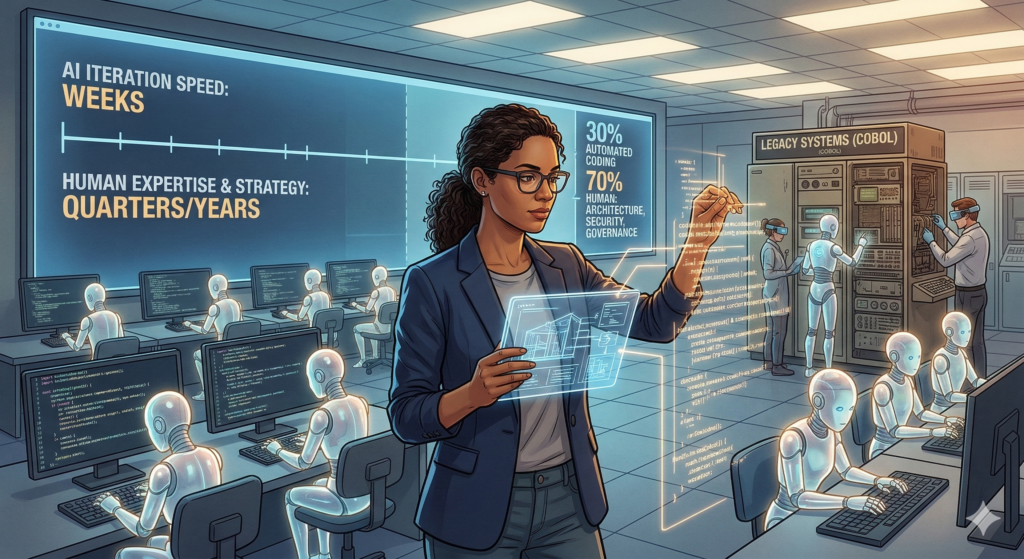
But here’s the critical distinction: coding is just one act in a much longer play. Industry analysis consistently shows that actual “coding” represents only about 30% of the software development lifecycle (SDLC) . The other 70%: requirements analysis, system design, architecture, testing, security, deployment, and maintenance, remains deeply complex and distinctly human, yet to be fully automated using AI.
As Cherny himself explained when questioned about why Anthropic is still hiring engineers despite AI writing nearly all their code: “Someone has to prompt the Claudes, talk to customers, coordinate with other teams, decide what to build next. Engineering is changing and great engineers are more important than ever” .
The role is evolving from builder to architect and reviewer. A junior developer might rely on AI for coding, but it takes experience and judgment to evaluate, accept, or reject that output. The demand for smart engineers who can provide architectural oversight, review AI-generated code for quality and security, and make high-level design decisions will only increase .
“Engineering is changing and great engineers are more important than ever.” — Boris Cherny, Head of Claude Code, Anthropic
2. The Security Paradox: AI as Defender and Attack Surface
On February 20, 2026, Anthropic unveiled Claude Code Security, an AI tool designed to scan codebases for vulnerabilities and suggest targeted patches . The announcement sent cybersecurity stocks into a tailspin—SailPoint and Okta dropped over 9%, Cloudflare fell 8%, and CrowdStrike nearly 8% . Investors clearly feared that AI would render traditional security tools obsolete.
But the reality is far more nuanced.
Claude Code Security works by reading and reasoning about code “the way a human security researcher would”—understanding component interactions, tracing data flows, and catching complex vulnerabilities that rule-based tools miss . Every finding goes through a multi-stage verification process, with Claude attempting to prove or disprove its own findings to filter out false positives. Crucially, “nothing is applied without human approval: Claude Code Security identifies problems and suggests solutions, but developers always make the call” .
Even more revealing: within days of its launch, security researchers from Check Point discovered critical vulnerabilities in Claude Code itself—flaws that could enable remote code execution and API key theft . The issues, tracked as CVE-2025-59536 and CVE-2026-21852, stemmed from configuration mechanisms including Hooks, Model Context Protocol (MCP) servers, and environment variables. Under certain conditions, simply opening an untrusted repository could trigger shell command execution .
This is the paradox of AI security: the same capabilities that help defenders find vulnerabilities could help attackers exploit them. Anthropic’s Frontier Red Team has been stress-testing these abilities for over a year, entering Claude in competitive Capture-the-Flag events and partnering with Pacific Northwest National Laboratory to defend critical infrastructure . Using Claude Opus 4.6, they discovered over 500 high-severity vulnerabilities in open-source codebases—bugs that had gone undetected for decades despite years of expert review .
Yet as Semgrep CEO Isaac Evans noted, the real test will be performance at scale: “So far none of the foundation model companies have published detailed statistics on how many false positives they experienced to get the results they had, or the cost to do so” . This matters because security isn’t just about finding bugs—it’s about triage, context, and judgment.
The takeaway? AI is a powerful amplifier for security teams, not a replacement. As Glenn Weinstein, CEO of Cloudsmith, put it: “Anything that helps developers write better, safer code is a good thing. Claude Code Security is one of many safeguards in a wide range of defences” .
3. The COBOL Modernization Boom: A Case Study in Opportunity
Perhaps nowhere is the “AI as amplifier” thesis more evident than in the modernization of legacy systems. Anthropic announced that Claude can now read, analyse, and modernize COBOL code—a programming language from 1959 that still runs critical systems across banking, aviation, and government.
Consider the scale: an estimated 95% of ATM swipe transactions still rely on COBOL . The pool of COBOL programmers, however, is retiring. This is where AI becomes a bridge, not a replacement.
Tools like Claude Code can analyse millions of lines of legacy code, map dependencies, and identify business logic that human analysts would take months to figure out. But the task is not just “re-coding”, it is reverse-engineering decades of business logic, testing new systems for compliance, and managing complex data migration.
This is a massive opportunity for IT service providers. Instead of losing work, they are being handed the keys to a multi-trillion-dollar modernization project. The work shifts from writing code to understanding systems—a distinctly human capability that AI augments but cannot replace.
4. The Fortress of Enterprise Systems: ERP and Beyond
Let me take up ERP—the backbone of our business. The integrity of master data, the complexity of end-to-end business processes, and the need for auditable, compliant transactions are areas where AI is a long way from taking full control.
We are moving toward “Conversational ERP,” where complex user interfaces are replaced by natural language chat. Users will be able to ask the system, “Run our month-end close tasks and show me anything unusual,” and an AI agent will begin the process. ServiceNow’s partnership with Anthropic demonstrates this shift: using Claude to power its Build Agent, ServiceNow is targeting a 50% reduction in time-to-implement for customers, and sellers using Claude-powered coaching tools have seen up to 95% reduction in preparation time .
But this requires skilled engineers to set up the underlying agents, APIs, and governance frameworks. The work shifts from clicking through menus to designing and supervising intelligent systems. And crucially, a learned financial auditor will trust a proven ERP system’s output long before they trust a black-box AI-generated one. Auditability demands human oversight.
5. AI Creates More Work for Engineers
Far from shrinking the industry, AI is expanding the scope of what is possible, which in turn creates more demand for engineering talent.
Product companies are now looking to build AI agents that solve thousands of niches, specific problems that were previously too costly to address with custom software. Tackling this “long tail” of use cases requires a massive engineering effort to build, deploy, and maintain these agents .
The rise of AI agents requires entirely new skill sets. Enterprises will need to invest in AI governance, multi-agent orchestration, and platform engineering to manage these new digital “coworkers.” Jack Clark, Anthropic’s co-founder, describes the new reality: in Anthropic, a single engineer often runs five or six Claudes simultaneously—some writing code, others fixing bugs, others running tests. One person effectively manages a small team of AI agents .
This creates new roles for developers, systems analysts, and security professionals who understand how to build and manage these complex, AI-augmented environments. As Clark observes, the most valuable people are those who can define objectives clearly—who can tell AI what to do, not just do what they’re told .
The next wave of AI is not just about generating text or code; it is about solving complex problems and reshaping the physical world—modernizing industrial supply chains, creating new tools for government services. All of these frontiers require massive amounts of custom software engineering to bring them to life.
The Speed Gap: Why Organizations Must Adapt
Perhaps the most challenging insight comes from Jack Clark’s recent interview: there is a growing speed gap between AI’s evolution and organizational adaptation .
- AI iteration speed: Weeks (new models every few months)
- Individual adaptation: Months (learning to work with AI)
- Organizational change: Quarters to years (restructuring processes, policies, governance)
This gap is widening because AI is beginning to improve itself. Anthropic is actively monitoring the proportion of “AI developing AI”—code written by AI to improve AI. Once this accelerates, human organizational speed will be left even further behind .
Clark warns that as teams delegate more execution to AI; management loses visibility into the work. Processes run faster, but humans understand less. Organizations must redesign workflows so that AI logs key decisions, enabling humans to monitor direction rather than every step .
Conclusion: The Future Is Smarter, Not Empty
What we are witnessing is a significant re-platforming of the industry. The “coding” part of the job is being automated, but the demand for the broader skills of a software engineer such as analysis, architecture, testing, security, domain expertise, and governance are not going away any sooner. They are evolving.
The impact on mechanical coding and BPOs will be felt sooner, with job losses and revenue pressure on companies that depend on them. But for those who embrace the shift who move from writing code to directing AI, from executing tasks to defining problems, the future is not jobless. It is smarter, more strategic, and ultimately more human.
The mirage is the belief that AI replaces human expertise. The reality is that AI amplifies it, but only for those who know how to wield it.
Key Takeaways
- AI Automates Coding, Not Engineering: Coding represents only ~30% of the software lifecycle. The remaining 70%—architecture, requirements, security, testing, and domain expertise—remains deeply human. Engineers evolve from builders to architects and reviewers, making great engineers more important than ever.
- AI Security Is a Double-Edged Sword: Claude Code Security finds vulnerabilities humans miss, yet flaws were discovered in Claude Code itself within days. AI amplifies both defenders and attackers, but the critical principle remains: AI suggests, humans decide.
- Legacy Systems Are AI’s Next Frontier: From modernizing COBOL systems running 95% of ATM transactions to orchestrating Conversational ERP, AI opens massive opportunities. But these tasks demand understanding business logic and ensuring compliance—capabilities where human expertise remains irreplaceable.