
The success stories are the ones that build systems designed to slot neatly into real workflows. The failures are the ones that try to slot generic AI into clunky processes and expect transformation to follow. Models that perform admirably on traditional training and validation sets can exhibit critical shortcomings during deployment when fundamental considerations are neglected. Traditional evaluation can characterize how well a model fits the patterns in its data. However, real-world conditions do not always mirror those in a model’s dataset.
Statistical rigor alone may not be sufficient for robust performance.
The Era of Evaluation
The field of AI has entered the second phase, the era of evaluation. Model enhancement no longer relies solely on training; rather, evaluation has become the primary driver of improvement.
This shift is driven by several converging factors:
- Benchmark saturation: Academic benchmarks like MMLU and HELM, while useful for early comparison are starting to hit saturation. Models like GPT-4 are nearing 90%+ accuracy on tests like MMLU. These benchmarks rarely reflect how models behave in the real world.
- The evaluation gap: A new analysis of 445 AI benchmarks revealed a shocking lack of statistical rigor, construct validity, and quality datasets. Research presented at NeurIPS 2025 found that 5% of popular AI benchmarks have fatal flaws.
- Regulatory mandates: The EU AI Act’s obligations for General-Purpose AI models came into force on August 2, 2025. Providers must perform model evaluation using standard protocols, identify and reduce systemic risks, and maintain detailed development documentation.
- The cost of failure: Forrester found that models were wrong 60% of the time; their combined performance led to more failed queries than accurate ones. Organizations must operate under the explicit assumption that AI systems will regularly fail.
The “Vibe Testing” Problem
In the world of LLMs, a dangerous practice has emerged: “vibe testing”, where developers tweak prompts, run them a few times, and declare the output “feels better”.
General benchmarks are generic tests measuring the model across a range of tasks, but they do not help you evaluate your AI stack based on your data and criteria. To know if your AI application really works for a specific use case, you need your own AI evals.
The Discovery Vector Perspective
In Issue 4 of AI Project Pulse, we introduced the concept of Discovery Vectors which is continuous lenses applied throughout the AI project lifecycle.
Technical Discovery is the vector that operates during the Model Design & Validation phase. It asks one fundamental question: Can we build a model that meets accuracy, fairness, robustness, and scalability goals?
Technical Discovery is recursive and iterative. As you experiment with architectures, you may discover that certain approaches do not work. As you validate, you may uncover fairness issues that demand different modelling choices. As you scale, you may find performance bottlenecks that require architectural changes.
Technical Discovery never truly ends because models drift, new architectures emerge, and validation requirements evolve.
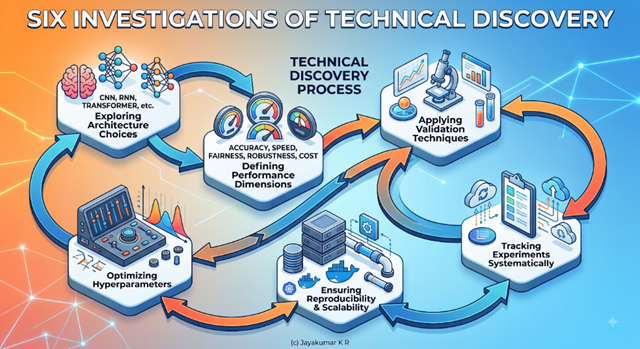
The Six Investigations of Technical Discovery
Technical Discovery is organized into six interconnected investigations that together provide a comprehensive framework for evaluating whether a model can meet accuracy, fairness, robustness, and scalability goals. The six investigations that cover the full spectrum of model design and validation are Exploring Architecture Choices, Defining Performance Dimensions, Applying Validation Techniques, Tracking Experiments Systematically, Optimizing Hyperparameters, and Ensuring Reproducibility & Scalability. Each investigation builds on the previous ones, yet each can also trigger revisits to earlier decisions as new information emerges. This recursive nature is by design as Technical Discovery never truly ends because models drift, new architectures emerge, and validation requirements evolve.
Investigation 1: Architecture Exploration
The landscape of AI architectures has expanded dramatically beyond traditional machine learning. Teams must navigate choices across predictive ML, generative AI, and agentic systems, each with its own subcategories, trade-offs, and use cases.
Predictive ML Architectures
For tasks involving classification, regression, prediction, and pattern recognition from structured or unstructured data.
- For tabular/structured data, small datasets, or regulated industries requiring interpretability: Classical ML algorithms remain the gold standard. This includes Random Forests, Gradient-Boosted Trees (XGBoost, LightGBM, CatBoost), and Support Vector Machines (SVMs). They offer the best performance on structured data, train quickly, and provide the explainability critical for compliance in finance, healthcare, and insurance.
- For image classification and computer vision tasks: Convolutional Neural Networks (CNNs) are the proven, efficient choice with a mature ecosystem and extensive pre-trained model availability.
- For time-series forecasting and sequential data : Recurrent Neural Networks (RNNs/LSTMs/GRUs) remain the well-understood, reliable choice for moderate-length sequences with established tooling and best practices.
- For general pattern recognition and as building blocks for complex architectures: Multi-Layer Perceptrons (MLPs) serve as foundational neural network components, used in transfer learning, embeddings, and as final classification layers in larger systems.
- For NLP classification, regression, and text embedding tasks (sentiment analysis, named entity recognition, text similarity, document classification): Encoder-only Transformer models like BERT, RoBERTa, and their variants provide pre-trained, fine-tuneable, best-in-class performance with extensive Hugging Face ecosystem support.
- For graph-structured data (social networks, molecular structures, knowledge graphs, recommendation systems): Graph Neural Networks (GNNs) are specifically designed to capture relational patterns that other architectures cannot effectively model.
- For very long sequence modelling (entire books, genomic sequences, long-document processing) where Transformer efficiency becomes a concern: State-Space Models (SSMs like Mamba) and hybrid linear attention architectures offer linear-time efficiency while maintaining competitive performance.
There is no single “best” architecture. Selection depends on data modality (tabular, text, image, graph), data volume, computational budget, and interpretability requirements. Classical ML remains the gold standard for tabular data; Transformers dominate NLP classification; emerging architectures expand the toolkit for specialized use cases.
Generative AI Architectures
For tasks involving content creation such as text, images, video, audio, and cross-modal generation.
For Generative and Content Creation Tasks:
- For open-ended text generation, reasoning, chat, code generation, or creative writing: Decoder-only LLMs (GPT, Claude, Llama, Gemini, Mistral) are the most versatile and mature option. They excel at general-purpose generation, in-context learning, and can adapt to new tasks with minimal prompting.
- For high-quality image and video generation: Diffusion Models (DALL-E, Stable Diffusion, Sora, Imagen) are the undisputed state of the art. They are particularly well-suited for scenarios where compute is abundant, but data is scarce, as they make more efficient use of limited training data compared to autoregressive approaches.
- For applications requiring grounded, factually accurate responses based on private or current data: Retrieval-Augmented Generation (RAG) Frameworks (FiD, Self-RAG, RAFT) are essential. By grounding generation in retrieved facts, RAG significantly reduces hallucinations and enables access to information not in the model’s training data such as proprietary documents or real-time information. RAG often achieves better, more balanced performance than fine-tuning alone.
- For understanding or generating across multiple modalities: Multimodal Generative Models (Flamingo, BLIP-2, LLaVA, VideoPoet) are required for tasks involving text, images, video, and audio together. They excel at visual question answering, image captioning, cross-modal search, and processing documents with charts, infographics, or other non-textual elements. These models are critical for enterprise applications involving multimodal documents, healthcare diagnostics, and robotics.
These are specialized tools for specialized jobs. Decoder-only LLMs are the most versatile; diffusion models excel at continuous data like images; RAG is essential for accuracy-critical applications; multimodal models are required for visual understanding. Effective systems increasingly combine multiple architectures as in a RAG pipeline using a decoder-only LLM with a multimodal model for document understanding.
Agentic AI Systems
For autonomous, goal-directed behaviour; systems that plan, act, learn, and collaborate with minimal human supervision.
- For foundational infrastructure to build any agent : Single-Agent Frameworks (LangChain, AutoGPT, LangGraph) provide the essential orchestration, tool calling, and state management capabilities. These are the starting point for any agentic system, offering reusable components for prompt chaining, output parsing, and tool definitions.
- For agents that need to interact with external systems and take real-world actions: Tool-Integrated Agents with function calling, API integration, code execution, and web search capabilities enable the agent to move beyond text generation into tangible action. These are essential when automation requires retrieving data from databases, sending emails, controlling APIs, or executing code.
- For complex problem-solving requiring structured reasoning, exploration of multiple solution paths, or self-correction: Planning and Reasoning Modules (ReAct, Tree-of-Thoughts, Reflexion, Chain-of-Thought) dramatically improve performance on tasks that simple agents fail to solve. These frameworks enable structured thinking, exploration of alternative approaches, and real-time learning from mistakes, making agent behaviour more reliable and transparent.
- For long-term context retention, learning from past interactions, or simulating outcomes before acting: Agentic Memory and World Models (vector databases like Pinecone and Weaviate, episodic and semantic memory systems, JEPA-style world models) provide persistence and adaptive learning. Memory enables agents to maintain context across sessions and improve over time; world models allow simulation of outcomes before costly real-world actions, making them critical for robotics, autonomous vehicles, and strategic planning.
- For tasks benefiting from role specialization, collaborative problem-solving, or human-in-the-loop oversight: Multi-Agent Orchestration (AutoGen, CrewAI, CAMEL, MetaGPT) enables multiple specialized agents to work together, each with separate roles, tools, or LLMs. This approach is valuable when tasks benefit from diverse perspectives, when human oversight is needed at specific decision points, or when problem complexity exceeds the capacity of a single agent.
Agentic systems are composed of layers, not chosen as single options. A simple automation might only need a single-agent framework with tool integration. A complex enterprise system may combine all components like planning for reasoning, memory for adaptation, and multi-agent orchestration for specialization. Teams must evaluate which layers are necessary for their application’s autonomy, reasoning, and adaptability requirements.
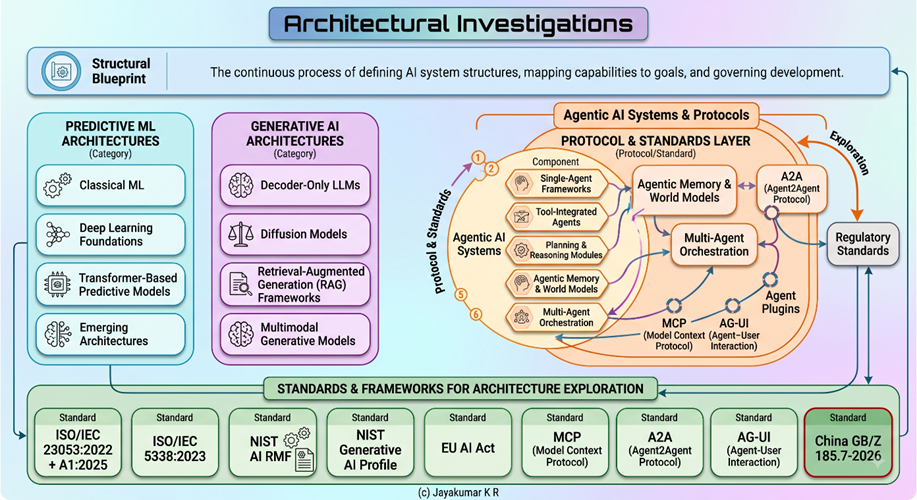
Protocol & Standards Layer
For integration, interoperability, and governance across AI systems.
Architecture choices today extend beyond selecting models. A modern AI application is rarely a single model, it is a system of components consisting of LLMs for reasoning, RAG for grounding, multimodal models for understanding, and agents for execution. These components must communicate with each other, with external tools, and with users. Without standardized protocols, teams build custom point-to-point integrations for every combination, creating brittle, unscalable, and ungovernable systems.
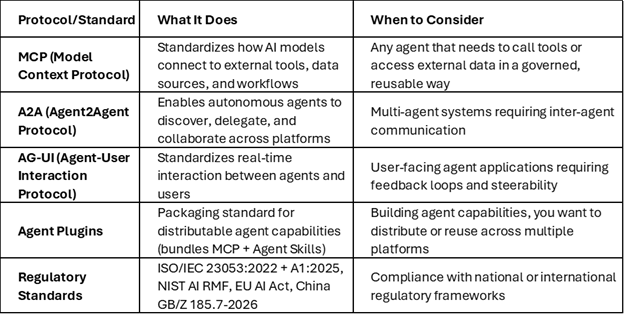
The protocol layer is the nervous system that enables architecture components to work together. Just as TCP/IP standardized internet communication, MCP, A2A, and AG-UI are emerging as the foundational standards for AI system integration. Selecting the right protocols is as important as selecting the right models. It determines whether your AI system can evolve, interoperate, and scale. Treating protocol selection as an afterthought is a primary cause of AI project failure. Teams must evaluate which protocols their architecture requires, which their frameworks support, and with which regulatory standards they must comply. They must also treat protocol selection as a first‑class architectural decision, not an afterthought.
Standards & Frameworks for Architecture Exploration
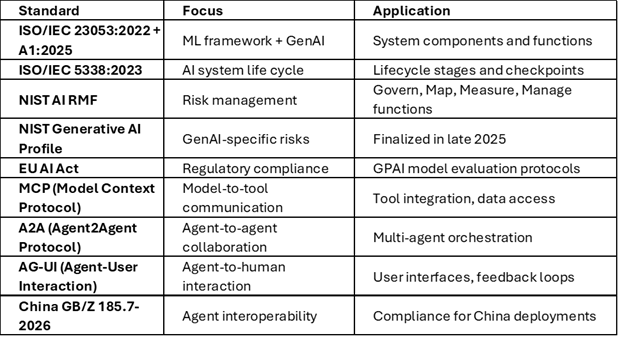
Architecture exploration is no longer just about choosing a model. It is about selecting an integrated stack that includes the right architecture for each capability, the right protocols for integration, and the right standards for governance. The Technical Discovery process must systematically evaluate these choices, not as isolated decisions, but as a cohesive system designed for real-world deployment.
A modern AI application might use a decoder-only LLM for reasoning, RAG for grounding, multimodal models for document understanding, and agentic frameworks for autonomous execution, all connected via MCP and A2A protocols. Technical Discovery must systematically evaluate which combination of architectures and protocols best serves the specific use case, rather than defaulting to the latest trend.
References
- Bean, A. M., Kearns, R. O., Romanou, A., et al. (2025). Measuring What Matters: Construct Validity in Large Language Model Benchmarks. Presented at the 39th Conference on Neural Information Processing Systems (NeurIPS 2025), San Diego, CA.
- Truong, S., Tu, Y., Hardy, M., et al. (2025). Fantastic Bugs and Where to Find Them in AI Benchmarks. Presented at NeurIPS 2025.
- Forrester Research (2025). Gen AI is a chaos agent: models are wrong 60% of the time. Presented at the Forrester Security and Risk Summit 2025.
- European Commission (2025). EU Artificial Intelligence Act — Obligations for General-Purpose AI (GPAI) Models. Came into force on August 2, 2025.
- ISO/IEC 23053:2022 + Amendment 1:2025. Framework for Artificial Intelligence Systems Using Machine Learning — Amendment 1: Generative AI.
- ISO/IEC 5338:2023. Information technology — Artificial intelligence — AI system life cycle processes. Published December 20, 2023.
- NIST (2023). Artificial Intelligence Risk Management Framework (AI RMF 1.0). Released January 26, 2023.
- NIST (2025). Generative Artificial Intelligence Profile (GenAI Profile). Final version released July 26, 2025.
- Anthropic (2024). Model Context Protocol (MCP). Released November 2024; donated to the Linux Foundation on December 9, 2025.
- Google (2025). Agent2Agent Protocol (A2A). Launched April 9, 2025; donated to the Linux Foundation on June 23, 2025.
- AG-UI Protocol (2025). Agent-User Interaction Protocol.
- Coalition for Secure AI (CoSAI) (2025). Principles for Secure-by-Design Agentic Systems. Released July 16, 2025.
- Cloud Security Alliance (CSA) (2025). Agentic AI Red Teaming Guide. Released May 28, 2025.
- Vercel, in collaboration with Amazon, Anysphere, GitHub, Microsoft, OpenAI, and Google (2026). Agent Plugins 1.0.0. Released August 6, 2026.
- Standardization Administration of China (SAC) (2026). GB/Z 185.7-2026 — Artificial intelligence — Agent interconnection — Part 7: Agent tool invocation. Published May 22, 2026.
© 2026, Jayakumar K R. All rights reserved.
This article and all its contents—whether in this form or any other form, format, or media—may not be copied, reproduced, distributed, adapted, translated, or quoted in whole or in part without the prior explicit written permission of the author.
Unauthorized use, sharing, or reproduction of this material is strictly prohibited.