
The Data Paradox: Abundance Meets Scarcity
The numbers paint a stark picture. Only 7% of enterprises say their data is completely ready for AI, down from already low levels in previous years. 73% report that processing and preparing data for AI remains a significant challenge. 81% of organizations still struggle with AI data quality, putting ROI and trust at risk.
This is the AI data paradox: despite an abundance of data globally, AI developers face a scarcity of usable data. The OECD (2025) warns of a looming data crunch.
The consequences are severe. Gartner predicts that through 2026, organizations will abandon 60% of AI projects unsupported by AI-ready data. A Cloudera/Harvard Business Review study found that siloed data and difficulty integrating data sources (56%) and lack of a clear data strategy (44%) are the top obstacles. Only 26% of Chief Data Officers are confident their data can support new AI-enabled revenue streams.
What makes these numbers particularly striking is that they are not improving. Despite massive investment in AI, foundational data readiness is actually declining . Organizations are accelerating AI initiatives faster than they are building the data foundations required to support them.
The AI Model is rarely the problem. The data almost always is.
The Discovery Vector Perspective
In Issue 4 of AI Project Pulse, we introduced the concept of Discovery Vectors, continuous lenses applied throughout the AI project lifecycle. We delved into details of Value Discovery, the Ideation & Feasibility phase of Managing Innovative AI Projects (MIAP) framework.
Data Discovery is the vector that operates during the Data Acquisition & Preparation phase. It asks one fundamental question: Do we have the right data which is sufficient, clean, unbiased, and lawful to build a successful AI solution?
This is not a one-time exercise. Data Discovery is recursive and continuous. As you clean and prepare data, you may discover quality issues that require revisiting sourcing decisions. As you annotate, you may uncover bias that demands new data acquisition. As you govern, you may find compliance gaps that necessitate process changes.
Data Discovery never truly ends — because data drifts, regulations change, and new sources become available.
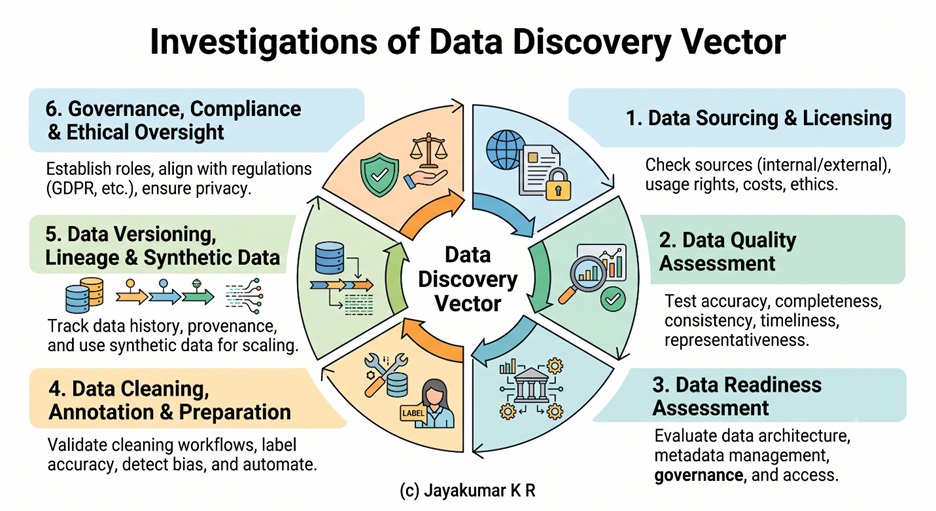
The Six Investigations of Data Discovery
Investigation 1: Data Sourcing & Licensing
The Challenge: Traditional “grab what you can” approaches to data sourcing are reaching their limits. Several copyright and data protection lawsuits have been filed worldwide related to AI training data. Websites are increasingly deploying technical and contractual barriers to prevent scraping.
What to investigate:
- Primary vs. secondary sources: Do we have internal data (sensors, logs, transactions, customer interactions) or must we acquire external datasets? Internal data is often more valuable but may require significant preparation.
- Licensing and usage rights: Open repositories may carry restrictions that affect deployment. The OECD warns that “vast amounts of valuable data remain locked away on private servers because concerns about legal risk and confidentiality inhibit sharing”.
- Data acquisition costs: Commercial datasets have cost implications that must be factored into the project budget.
- Ethical sourcing: The VIADUCT report (2025) argues for moving “beyond extraction towards mutually beneficial data-sharing arrangements, including commercial and non-commercial agreements”.
The critical insight: Data sourcing is no longer a purely technical exercise. It is a legal, ethical, and strategic one. Organizations must move from “scraping” to “sustainable and ethical data sharing”.
Investigation 2: Data Quality Assessment
The Challenge: 74% of organizations plan significant AI investments. 98% of enterprises acknowledge poor data quality as a critical barrier holding back AI adoption.
What to investigate:
Data quality spans multiple testable dimensions:
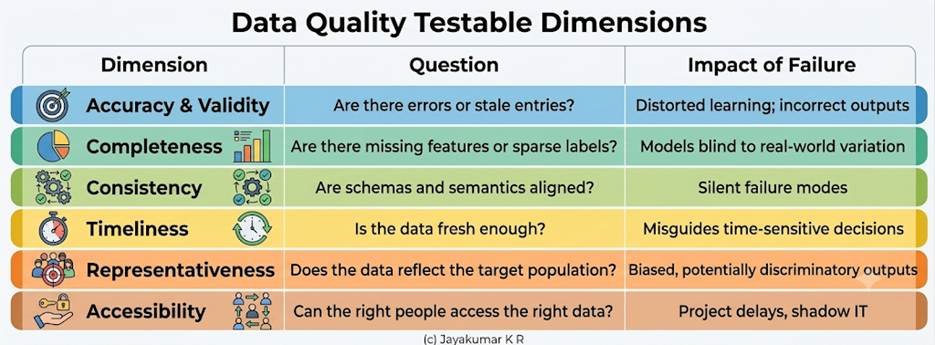
The critical insight: Data quality is not a binary state. It exists on a spectrum, and different use cases demand different levels of quality. The question is not “is our data perfect?” but “is our data fit for purpose?”
Investigation 3: Data Readiness Assessment
The Challenge: Gartner’s research identifies metadata management as the single highest technical driver of AI-ready data maturity. Organizations that adopt these capabilities are more likely to achieve high effectiveness in data engineering for AI use cases.
What to investigate:
- Data architecture: IDC reports that 40% of organizations consider building AI-ready data architecture a top investment priority for 2025.
- Metadata management: “Data takes on different meanings depending on business context, and without that context, AI systems risk generating unreliable or misleading outputs”.
- Data governance: “In 2025, leading firms are recognizing that data governance is not optional; it is central to AI safety”.
- Data accessibility: 82% of CDOs say data is wasted if their organization isn’t giving people access to it.
The critical insight: Data readiness is not about having more data; it’s about having the right data, properly governed, with clear context.
Investigation 4: Data Cleaning, Annotation & Preparation
The Challenge: Data preparation is where most projects stumble. 73% of organizations have found the processing and preparing of data for AI to be challenging. 22% of AI projects stall because of weak data pipelines.
What to investigate:
- Cleaning workflows: Start with a representative subset to validate cleaning workflows consisting of handling missing values, outliers, schema mismatches, and duplicates.
- Annotation strategy: Use semi-automated annotation tools with human-in-the-loop review to ensure label accuracy and consistency.
- Bias detection: Apply bias detection tests early to correct under-represented segments.
- Automation: AI-driven solutions can improve data quality by 78% on average and reduce manual governance tasks by 82% (IEEE Systematic Literature Review (2025).
The critical insight: Data preparation is a disciplined, repeated process that is as essential as model architecture. Teams must invest in automation to scale.
Investigation 5: Data Versioning, Lineage & Synthetic Data
The Challenge: As AI models become more complex and regulated, the ability to track data provenance and lineage becomes mission critical.
What to investigate:
- Data version control: Employ systems to track snapshots, transformations, and lineage. Maintain immutable storage of each data version to support auditability and rollback.
- Lineage tracking: The NIST AI Risk Management Framework “elevates data provenance, quality, and bias mitigation as central to trustworthy AI”.
- Synthetic data generation: Synthetic data has emerged as a “viable alternative” for scaling training data. Synthetic data pipelines are “becoming essential for AI development, offering efficient, privacy-friendly, and scalable solutions”.
- Synthetic data mixture: In order to balance cost efficiency with reliability and bias control, Industry practice among top AI teams appears to be 70–80 % human‑labelled and 20–30 % synthetic (Sourcebae, LinkedIn (2026).
The critical insight: Data versioning and lineage are regulatory requirements for many AI applications. Synthetic data is a powerful tool but requires careful quality management.
Investigation 6: Governance, Compliance & Ethical Oversight
The Challenge: “Traditional governance systems face substantial challenges from issues such as data bias, data quality and the complexity of managing AI-driven datasets”.
What to investigate:
- Governance framework: Define roles. Data engineers ingest and transform; stewards enforce quality and lineage; scientists explore and validate. Use established standards/ frameworks.
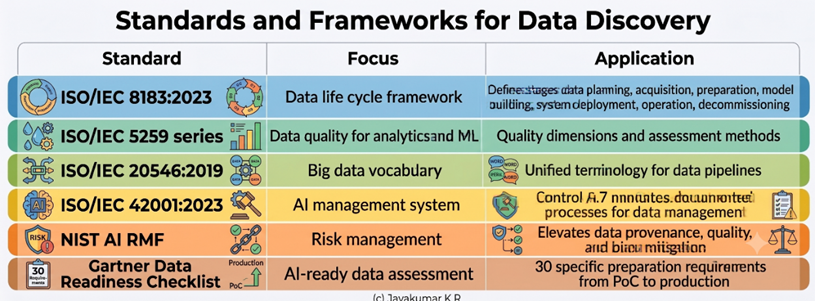
- Regulatory alignment: Align with GDPR, EU AI Act, HIPAA, or sector-specific rules.
- Privacy and security: Protecting sensitive data and privacy are the most critical component of their data strategy.
- Audit trails: Record data provenance in a centralized catalogue to facilitate audits and compliance checks.
The critical insight: Governance must be embedded from the start. Success in AI hinges not only on the sophistication of algorithms or the sheer volume of data but also on a foundation of data trust.
Data Discovery Across AI Project Types
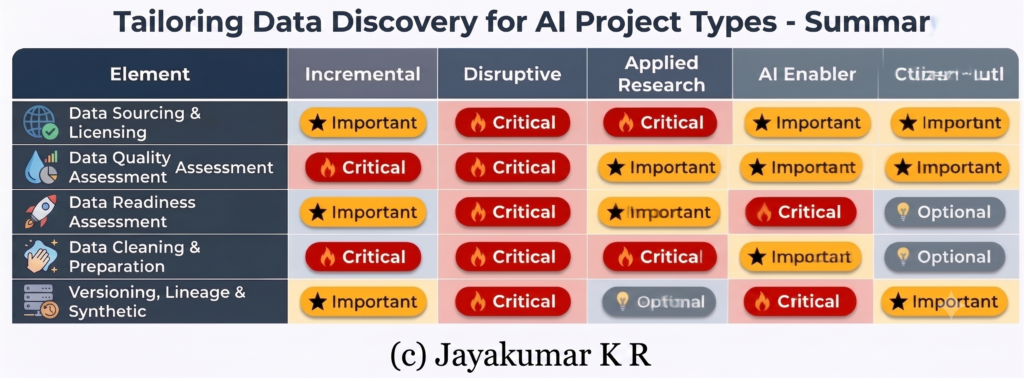
The six investigations of Data Discovery are not one-size-fits-all. Their importance shifts dramatically depending on the type of AI project. What is absolutely critical for a Disruptive Innovation project may be entirely optional for Citizen-Led Innovation. Read about AI Project Types in AI Project Typology. (link to be provided)
Below is a project-type-specific breakdown of the Data Discovery elements, classified as:
- Critical — Must be performed; project cannot proceed without it.
- Important — Should be performed; adds significant value.
- Optional — May be performed if resources permit; situational.
The Data Readiness Go/No-Go Decision
At the end of Data Discovery, the team must answer: Do we have sufficient evidence that our data can support a successful AI solution?
A GO decision requires:
- Data sources identified with confirmed access and acceptable licensing
- Quality assessment completed with no unresolvable issues
- Bias assessment performed with mitigation plan for identified biases
- Governance framework established with clear roles and responsibilities
- Compliance requirements mapped with no unresolvable blockers
- Versioning and lineage plan in place for auditability
- Costs estimated within 20% of planned spend
A NO-GO decision is successful discovery as it saves months of wasted effort and prevents the cascading failures that come from building on poor data foundations.
The most common mistake in AI project management is treating data discovery as a one-time technical task rather than a continuous strategic discipline.
- Incremental Innovation projects fail when teams assume existing data quality is sufficient and skip validation.
- Disruptive Innovation projects fail when teams underestimate the data challenge and discover too late that the data doesn’t exist or can’t be accessed.
- Applied Research projects fail when teams don’t invest in reproducibility and can’t validate results.
- AI Enabler projects fail when teams build tools that don’t support governance and lineage.
- Citizen-Led projects fail when teams skip governance entirely and create unmanageable shadow AI.
The right data foundation at the right level of rigor is the difference between AI success and failure.
References
- Cloudera/Harvard Business Review Analytic Services (2026). Taming the Complexity of AI Data Readiness
- Gartner (2025). State of AI-Ready Data Survey
- Gartner (2025). Predicts: 60% of AI Projects Will Be Abandoned Through 2026
- IBM Institute for Business Value (2025). 2025 CDO Study
- IDC (2025). Data Management Analysis and GenAI Development Trends and Best Practices
- ISO/IEC 8183:2023. Artificial intelligence — Data life cycle framework
- ISO/IEC 42001:2023. Artificial intelligence — Management system framework
- ISO/IEC 5259 series. Data quality for analytics and machine learning
- IEEE Systematic Literature Review (2025). AI-Driven Approaches for Optimising Data Governance
- NIST (2023). AI Risk Management Framework (AI RMF 1.0)
- OECD (2025). Mapping Relevant Data Collection Mechanisms for AI Training
- OECD/VIADUCT (2025). From Scraping to Ethical Data Sharing
- Qlik (2025). AI Data Quality Research
- Semarchy (2025). Bridging the AI Data Gap Report
- Sourcebae (2026). “Emerging Practices in Synthetic Data Ratios for AI Training.” LinkedIn Industry Insights, published March 2026.
This framework extends the Data Acquisition & Preparation phase of the Managing Innovative AI Projects (MIAP) framework, integrating the Data Discovery Vector perspective introduced in AI Project Pulse Issue 4.
© 2026, Jayakumar K R. All rights reserved.
This article and all its contents—whether in this form or any other form, format, or media—may not be copied, reproduced, distributed, adapted, translated, or quoted in whole or in part without the prior explicit written permission of the author.
Unauthorized use, sharing, or reproduction of this material is strictly prohibited.
Share your data discovery stories or how you approach Data Acquisition & Preparation: ManageAIprojects@gmail.com