
Abstract
Commercial GRC platforms cost a fortune but cannot see the code AI writes. Open-source tools are free but do not govern themselves.
This article maps the landscape of AI governance tools from Credo AI and IBM watsonx.governance to a growing ecosystem of open‑source alternatives like PyRIT, RuleHub, and Permiscope. It explains what you gain (policy automation, bias dashboards, audit trails) and what you lose (centralized control, out‑of‑the‑box compliance, SLAs).
A real‑world warning: the OpenClaw incident exposed 21,000 ungoverned AI instances leaking secrets. The article concludes with a hybrid model and highlights the single biggest gap, code‑level AI governance, that no tool fully solves today.
In our first two issues of newsletter, we mapped the five categories of specialized tools that enable successful AI project delivery and clarified what we mean by “AI Toolscape”—the governance, monitoring, evaluation, and orchestration layer that transforms prototype code into trustworthy business assets.
Now, we turn to the foundational category: AI Governance, Risk & Compliance (GRC) platforms. They establish the ethical and regulatory foundation from the moment an idea is first conceived. They ensure that every subsequent decision about data, models, and deployment remains aligned with organizational policies and external regulations, from the earliest feasibility discussions through to long-term operations.
But here is the reality. These platforms are often “heavy” and expensive, designed primarily for large enterprises with dedicated governance teams. For smaller organizations, startups, or teams wanting to experiment before committing, the cost and complexity can be prohibitive. So, we will also explore a critical question: What can you achieve with open-source and free tools, and where do they fall short?
The Core Problem GRC Platforms Solve
Traditional software governance tools were designed for deterministic systems. AI systems break that model. They require answers to questions that conventional tools never needed to ask:
- Is our model fair across all demographic groups?
- Has data drift compromised our predictions since last month?
- Can we prove to regulators that this AI system was developed responsibly?
- How do we detect and respond when an AI agent behaves unexpectedly?
According to Gartner’s 2025 Market Guide on AI Governance Platforms, core requirements include lifecycle management, policy enforcement, and compliance capabilities aligned with emerging regulations like the EU AI Act.
The leading platforms Credo AI, IBM watsonx.governance, and Monitaur—provide strong model-level oversight but still lack visibility into AI-generated code, which now represents 41% of global code.
While model-level control is essential, it remains insufficient, leaving a governance gap. We will take a bird’s eye view look at the first set of commercial tools and open-source alternatives in this part.
The Commercial Leaders: Overview and Capabilities
Credo AI
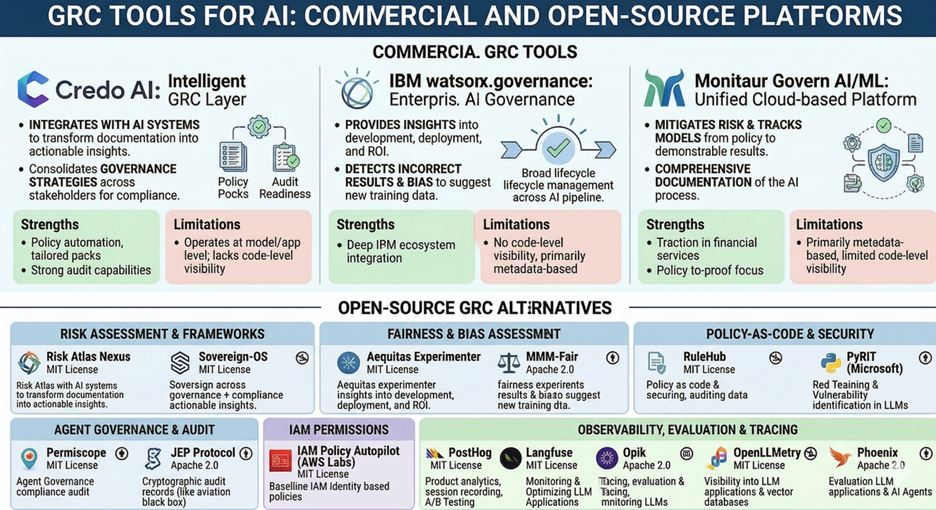
Credo AI positions itself as an intelligent layer that integrates with your AI systems, transforming technical documentation into actionable risk and compliance insights for product managers, data scientists, and governance experts. The platform consolidates AI governance strategies across diverse stakeholders, ensuring protocols are optimized for regulatory compliance while thoroughly evaluating AI-related risks.
Key Strengths:
- Policy automation with AI Policy Packs tailored to existing and forthcoming compliance requirements.
- Strong audit readiness capabilities.
Limitations: Operates at the model and application level; lacks repository access to track AI-generated code at the commit and pull request level.
IBM watsonx.governance
IBM’s enterprise framework provides organizations with insights into AI development, deployment outcomes, and return on investment. It automatically detects when AI systems yield incorrect results during operation, adheres to fairness guidelines set by the organization, and mitigates bias by suggesting new data for model training .
Key Strengths:
- Broad lifecycle management across the entire AI pipeline.
- Deep integration with IBM’s broader enterprise ecosystem.
Limitations: Lacks code-level visibility into AI-generated contributions; primarily metadata-based governance.
Monitaur
Monitaur’s GovernML platform brings together teams on a unified cloud-based platform designed to mitigate risks and track AI/ML models from foundational policies to demonstrable performance results. It features user-friendly workflows that comprehensively document the entire AI process in one centralized location.
Key Strengths:
- Strong traction in financial services and regulated industries.
- Focus on policy-to-proof management.
Limitations: Like its competitors, primarily metadata-based with limited code-level visibility.
The Open-Source Alternative: Building GRC Capabilities Without the Price Tag
For organizations not ready to invest in commercial platforms, or those wanting to build internal capabilities first, a growing ecosystem of open-source tools can address many GRC requirements, though not all.
- Risk Atlas Nexus – IBM Research’s open‑source system for governing AI risks, providing a common ontology for risk classification, estimation methodologies, and mitigation recommendations linked to identified risks for specific AI use cases.
- Sovereign‑OS – MIT‑licensed charter‑governed operating system for autonomous AI agents that enforces fiscal constraints, uses an earned‑permission TrustScore model, and generates verifiable audit trails for accountability.
- Aequitas Experimenter – Open‑source fairness assessment platform in the making from the Horizon Europe project that propose to translate abstract legal requirements (such as the EU AI Act) into actionable technical fairness metrics through a context‑sensitive question‑answering mechanism.
- MMM‑Fair – Open‑source fairness evaluation toolkit supporting multiple fairness definitions, target variables, and protected attributes, featuring a no‑code, LLM‑powered interface for accessible bias assessment.
- RuleHub – MIT‑licensed Policy‑as‑Code framework for securing and auditing AI pipelines using OPA and Kyverno, with SBOM/AIBOM generation, LLM guardrails, and EU AI Act compliance mappings.
- PyRIT (Microsoft) – Microsoft’s Python Risk Identification Tool under MIT License for red‑teaming generative AI systems, automating jailbreaking detection, prompt injection testing, and security vulnerability identification for LLMs.
- Permiscope – MIT‑licensed infrastructure layer that mediates AI agent actions through a secure execution gateway, enforcing least privilege with ALLOW/BLOCK/REQUIRE_APPROVAL decisions and generating HMAC‑SHA256 tamper‑proof audit logs.
- JEP Protocol – Open standard (Judgment Event Protocol) from HJS Foundation that generates cryptographic audit records for AI decisions using four primitives—Judge, Verify, Delegate, terminate—functioning like an aviation black box for verifiable human oversight.
- IAM Policy Autopilot (AWS Labs) – AWS open‑source static code analysis tool (CLI and MCP server) that analyses Python, Go, and TypeScript code locally to generate baseline IAM identity‑based policies, accelerating permission creation for application roles.
- PostHog – MIT‑licensed all‑in‑one platform for product analytics, session recording, feature flags, and A/B testing that now includes LLM observability, with self‑hosting options and 100k free monthly events on cloud.
- Langfuse – MIT‑licensed LLM observability platform providing tracing, prompt management, evaluations, annotation queues, and a playground for monitoring and optimizing LLM applications with self‑hosting flexibility.
- Opik – Apache 2.0‑licensed evaluation platform for LLM systems by Comet, offering comprehensive tracing, evaluation, and monitoring capabilities to help build, evaluate, and optimize LLM systems that run better, faster, and cheaper.
- OpenLLMetry – Open‑source observability framework built on OpenTelemetry standards (via Traceloop SDK) that provides visibility into LLM applications, vector databases, and AI frameworks by collecting traces, metrics, and events across the complete request lifecycle.
- Laminar – MIT‑licensed open‑source platform for engineering LLM products with automatic OpenTelemetry instrumentation, evaluation framework for scoring executor outputs, and agent orchestration capabilities.
- Phoenix – Arize AI’s open‑source, self‑hosted observability platform for monitoring, debugging, and evaluating LLM applications and AI agents at scale with comprehensive tracing capabilities and evaluation tools.
Mapping Tools to GRC Functions
| GRC Function | Commercial Tools (Credo AI, IBM, Monitaur) | Open-Source Alternatives |
| Risk Management | Centralized risk registers, automated risk scoring, risk dashboards | Risk Atlas Nexus (IBM) – AI risk classification and mitigation recommendations ; Sovereign-OS – charter-governed fiscal and permission controls with verifiable audit |
| Bias & Fairness | Built-in bias dashboards, mitigation recommendations | Aequitas Experimenter (Horizon Europe); MMM-Fair (multi-dimensional fairness) |
| Policy Management | Centralized policy libraries, automated enforcement | RuleHub – Policy-as-Code with OPA/Kyverno, MIT licensed |
| LLM Guardrails / Security | Content filtering, red-teaming features | PyRIT (Microsoft) – red-teaming and jailbreaking detection, MIT licensed ; Permiscope – granular action control with approval workflows, MIT licensed |
| Audit Trails | Immutable logs, compliance reporting | Permiscope – HMAC-SHA256 tamper-proof audit logs with hash chaining ; JEP Protocol – cryptographic audit records for human oversight |
| Repository-Level Governance | None (code-level gap) | IAM Policy Autopilot – IAM policy generation from code analysis ; Permiscope (dry-run) – simulation and shadow mode testing |
| Observability Integration | Vendor-specific telemetry | PostHog, Langfuse, Opik, OpenLLMetry, Laminar, Phoenix – all MIT/Apache 2.0 licensed with OpenTelemetry support |
The Open-Source Gap: What You Lose
The OpenClaw governance failure in early 2026 demonstrated precisely what happens when AI adoption outpaces governance. OpenClaw, an open‑source AI agent that started as a weekend project, has rapidly become the fastest‑growing open‑source initiative on record, surpassing 176,000 GitHub stars within three weeks and seeing shadow‑AI usage among 22% of enterprise employees. Within days, 21,000 exposed instances were discovered online, many leaking API keys and chat histories.
This is not a condemnation of open source. It is a warning about governance without structure. Open-source tools provide the capabilities, but they do not implement all the controls. The gaps fall into three categories:
1. Centralized Visibility and Control
Commercial GRC platforms provide a single pane of glass across all AI initiatives. Open-source tools are typically point solutions. You might use Aequitas for bias, GenOps for cost, and RuleHub for policy—but connecting them into a unified governance layer requires significant engineering effort.
2. Regulatory Compliance Out of the Box
Commercial platforms maintain up-to-date policy packs aligned with evolving regulations like the EU AI Act, GDPR, and sector-specific requirements. Open-source tools require your team to interpret regulations and encode them as policies manually.
3. Enterprise Support and SLAs
When a commercial platform fails during an audit, there is a vendor to call. When the open-source governance stack breaks, internal team owns the problem. For regulated industries, this is non-negotiable.
A Hybrid Approach: When Open-Source Makes Sense
For many organizations, the path is not “commercial or open-source” but “both.” Here are three scenarios where open-source tools are a strong choice:
1.Early‑StageStartups
Startups need governance capabilities to build trust with customers and investors, but enterprise licensing costs are prohibitive. Start with MMM‑Fair for no‑code fairness evaluation, PyRIT for security red‑teaming and jailbreaking detection, and Permiscope for basic audit trails and action‑level controls. Document everything manually as audit trails matter more than automation.
2.Platform Engineering Teams
If the team has the expertise to build and maintain internal tools, open‑source gives flexibility that commercial platforms cannot match. RuleHub brings Policy‑as‑Code (OPA/Kyverno) directly into your CI/CD pipelines. Permiscope adds granular agent governance with tamper‑proof logging. Observability tools like Langfuse,Opik, or Phoenix provide full‑stack monitoring.
3. Research and Academic Environments
Where reproducibility and transparency matter more than commercial support, open‑source tools provide verifiability that black‑box platforms cannot. MMM‑Fair supports fairness research with its multi‑definition evaluation. PyRIT enables systematic red‑teaming experiments. JEP Protocol offers cryptographically verifiable audit records for decision accountability. Risk Atlas Nexus helps structure risk ontologies, and observability stacks like OpenLLMetry ensure every experiment is fully traceable.
What Remains Unaddressed by Open-Source
The critical gap that neither commercial nor open-source tools fully address today is code-level AI governance. As Gartner’s analysis reveals, traditional governance platforms focus on model-level metadata and policy enforcement but cannot see the 41% of code now generated by AI tools. This is not a minor oversight; it is the blind spot where most operational risk now lives.
Emerging commercial tools like Exceeds AI are beginning to address this by providing repository access and commit/PR-level visibility, but open-source has not yet caught up.
For engineering leaders, this means governing AI is not just about the models. It is about the code that AI writes, the agents that run it, and the systems it touches.
Key Takeaways
- Commercial GRC Platforms Deliver Model-Level Governance – Credo AI, IBM watsonx.governance, and Monitaur provide strong policy automation, audit readiness, and compliance management. They provide no visibility into AI-generated code at the commit and pull request level.
- Open‑Source Tools Can Cover Many GRC Functions – Tools such as MMM‑Fair (fairness),PyRIT (security/red‑teaming),RuleHub (policy‑as‑code),Permiscope (audit trails and action governance), and Langfuse/Opik/Phoenix (observability) together address fairness, security, policy enforcement, auditability, and compliance mapping. They require internal expertise to integrate and maintain but offer flexibility and zero licensing costs.
- The Hybrid Model Is the Pragmatic Path– For most organizations, the choice is not binary. Use open-source for specific capabilities (bias testing, cost tracking, policy-as-code) while building toward commercial platforms as scale and regulatory requirements demand enterprise-grade support and unified visibility.
- The Code-Level Governance Gap Remains– Neither commercial nor open-source tools fully address the challenge of tracking and governing AI-generated code across repositories. This is the frontier where novel solutions, and new risks will emerge.
What’s Next in This Series: In upcoming issues of newsletter, while we bring out more tools in the GRC category, and dive deeper moving from a bird’s‑eye view down to the ground level, examining essential tools in detail. We will continue this pattern across the remaining AI Toolscape categories such as observability, evaluation, orchestration, and incident management, bringing you practical insights you can apply immediately.