
Technical Discovery is the vector that operates during the Model Design & Validation phase. It asks one fundamental question: Can we build a model that meets accuracy, fairness, robustness, and scalability goals?
Technical Discovery is recursive and iterative. As you experiment with architectures, you may discover that certain approaches do not work. As you validate, you may uncover fairness issues that demand different modelling choices. As you scale, you may find performance bottlenecks that require architectural changes.
Technical Discovery never truly ends because models drift, new architectures emerge, and validation requirements evolve.
The Six Investigations of Technical Discovery
Technical Discovery is organized into six interconnected investigations that together provide a comprehensive framework for evaluating whether a model can meet accuracy, fairness, robustness, and scalability goals. The six investigations that cover the full spectrum of model design and validation are Exploring Architecture Choices, Defining Performance Dimensions, Applying Validation Techniques, Tracking Experiments Systematically, Optimizing Hyperparameters, and Ensuring Reproducibility & Scalability. Each investigation builds on the previous ones, yet each can also trigger revisits to earlier decisions as new information emerges. This recursive nature is by design as Technical Discovery never truly ends because models drift, new architectures emerge, and validation requirements evolve.
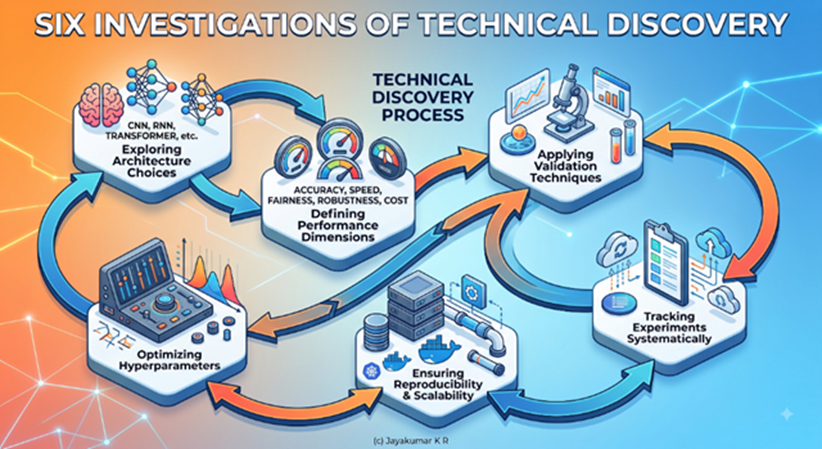
© 2026, Jayakumar K R. All rights reserved.
This article and all its contents, whether in this form or any other form, format, or media shall not be copied, reproduced, distributed, adapted, translated, or quoted in whole or in part without the prior explicit written permission of the author.
Unauthorized use, sharing, or reproduction of this material is strictly prohibited.