
Discovery Vectors – A New Way to Navigate AI Projects
We introduced the idea that AI projects are fundamentally discovery‑driven, not requirements‑driven. Success comes from structured learning across multiple dimensions.
Now, in Issue 4, we take the next step: Discovery is not a separate activity, it is the lifecycle. But we need a new language to talk about it. The old “life cycle” implies sequential phases you complete and close. AI projects do not work that way.
We propose a new construct: Discovery Vectors.
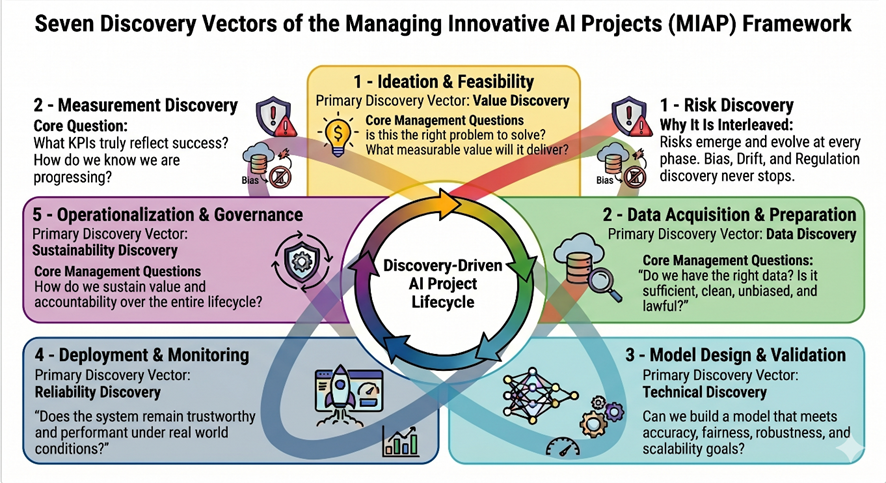
A vector is a directed force; it has magnitude and orientation. In an AI project, multiple discovery vectors operate simultaneously, continuously, and iteratively. They are not phases; they are lenses you apply at every stage. Some vectors are anchored in specific phases; others cut across everything.
The Seven Discovery Vectors of the Managing innovative AI Projects (MIAP) Framework
Five Primary Vectors
| AI Project Life Cycle Phase | Primary Discovery Vector | Core Management Question |
| 1- Ideation & Feasibility | Value Discovery | Is this the right problem to solve? What measurable value will it deliver? |
| 2- Data Acquisition & Preparation | Data Discovery | Do we have the right data? Is it sufficient, clean, unbiased, and lawful? |
| 3- Model Design & Validation | Technical Discovery | Can we build a model that meets accuracy, fairness, robustness, and scalability goals? |
| 4- Deployment & Monitoring | Reliability Discovery | Does the system remain trustworthy and performant under real‑world conditions? |
| 5- Operationalization & Governance | Sustainability Discovery | How do we sustain value and accountability over the entire lifecycle? |
Two Cross‑Cutting Vectors (Run Through All Phases)
| Cross‑Cutting Vector | Core Question | Why It Is Interleaved |
| 1- Risk Discovery | What could go wrong – technically, ethically, operationally – and how do we mitigate it? | Risks emerge and evolve at every phase. Bias can appear in data. Drift can appear after deployment. Regulation can change overnight. Risk discovery never stops. |
| 2- Measurement Discovery | What KPIs truly reflect success? How do we know we are progressing? | Indicators must evolve with the project. A KPI that worked in ideation may be useless in production. Measurement discovery is the continuous calibration of how we define and track value. |
Together, these seven vectors form the Discovery‑Driven AI Project Lifecycle. They are not sequential; they are simultaneous, overlapping, and recursive.
Deep Dive into Value Discovery (Ideation & Feasibility)
Value Discovery asks one fundamental question during Ideation & Feasibility: Is this problem worth solving with AI, and will it deliver measurable value?
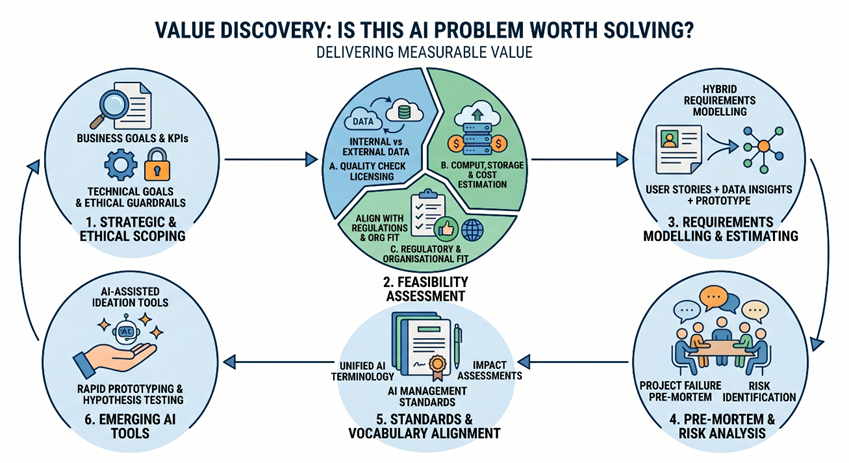
Based on the APLC framework from Managing Innovative AI Projects, Value Discovery comprises six interconnected investigations.
1. Strategic & Ethical Scoping (with technical implications)
Before any code is written, the team must articulate clear business goals mapped to measurable KPIs. But from a technical discovery perspective, this also means identifying which technical indicators (accuracy, latency, fairness thresholds) will drive go/no‑go decisions. Ethical guardrails such as privacy, explainability, and human‑in‑the‑loop requirements directly constrain technical architecture choices.
2. Feasibility Assessment – The Technical Core
a. Data Availability & Quality
- Primary vs. secondary sources: Do we have internal data (sensors, logs, transactions) or must we acquire external datasets?
- Sampling bias assessment: Early statistical tests can reveal whether available data represents the target population.
- Licensing and usage rights: Open repositories may carry restrictions that affect deployment.
Gartner (2025) warns that 60% of AI projects will be abandoned through 2026 due to lack of AI‑ready data. Technical discovery forces you to confront this before committing to a full build.
b. Computational Resource Estimation
- Estimate compute, storage, and latency needs using prototype benchmarks or historical data.
- For generative AI or large models, cloud cost forecasting becomes a technical risk factor. McKinsey (2025) reports that uncontrolled inference costs are the second leading cause of pilot termination.
c. Regulatory & Organisational Fit
- Align with GDPR, EU AI Act, HIPAA, or sector‑specific rules. Technical discovery includes checking whether your planned architecture can support required audit trails, data residency, and model explainability.
3. Hybrid Requirements Modelling & Estimating
Traditional requirements documents fail. Instead, the APLC recommends hybrid modelling – merging user stories, data‑driven insights, and prototype learnings. Sizing techniques such as COSMIC functional sizing (ISO 19761 cosmic-sizing) and its associated guidelines for early software sizing can quantify scope and estimate effort even when requirements are uncertain. This is a technical discovery tool, not a bureaucratic exercise.
4. Premortem Analysis & Risk Stress‑Testing
Host a premortem workshop before building. Ask: “If this project fails six months from now, what went wrong technically?” Common answers include:
- The data contained hidden biases that destroyed fairness indicators
- Latency exceeded SLAs once deployed at scale.
- The model could not generalise to edge cases.
These insights feed directly into a technical risk register that prioritises proof‑of‑concept focus.
5. Standards & Vocabulary Alignment
Technical discovery is not guesswork. Use established standards such as ISO/IEC 22989 for unified AI terminology, ISO 42001 for AI management system framework, ISO/IEC 42005 for early AI system impact assessments, and ISO/IEC TR 24030 for cataloguing use cases. These standards help technical teams communicate clearly with business and compliance stakeholders.
6. Emerging AI‑Assisted Ideation Tools
Technical discovery today can be augmented with GenAI co‑creators. Tools that support semantic clustering and rapid prototyping (Ye et al., 2025) allow teams to test multiple technical hypotheses in parallel. However, guard against automation bias – human technical judgement remains final.
Discovery in Action: A Value‑Driven Go/No‑Go Decision
At the end of Ideation & Feasibility, the team must answer: Do we have sufficient evidence that this AI initiative will deliver value?
A go decision requires:
- A clear, measurable value criterion (e.g., “prototype reduces manual processing time by 40% with 90% user acceptance”).
- Identified data sources with confirmed access.
- Modelling/ Inference budget estimated within 20% of planned spend.
- No unresolvable regulatory blockers.
- A documented risk register with mitigation plans for top three value‑related risks.
A no‑go decision is successful discovery – it saves months of wasted effort.
What This Means for Your AI Project
Value Discovery is the most leveraged investment you can make. It answers “should we?” before you commit to “how we will.” And it never truly ends – because Risk Discovery and Measurement Discovery will keep asking questions as the project evolves.
In the next MIAP stream issue, we will cover Data Discovery (Data Acquisition & Preparation). In subsequent rotations, we will explore Technical Discovery, Reliability Discovery, Sustainability Discovery – and the cross‑cutting vectors of Risk and Measurement.
This newsletter series is based on “Managing Innovative AI Projects” (Jayakumar K R and Prof. Alain Abran, 2025).
References
- COSMIC Measurement Manual v5.0 Part 1: Principles, Definitions & Rules
- Gartner (2025). Predicts 2025: AI and Data Management.
ISO/IEC 19761:2011. Functional size measurement – COSMIC method. - ISO/IEC 22989:2022. AI concepts and terminology.
- ISO/IEC 42001:2023. AI management system framework.
- ISO/IEC 42005:2025. Guidance for early AI system impact assessments.
- McKinsey Global Institute (2025). The state of AI in production.
- Plätke, O. & Geibel, R.C. (2024). The use of AI for idea generation in the innovation process.
- Ye, R. et al. (2025). The design space of recent AI‑assisted research tools for ideation, sensemaking, and scientific creativity.
Share your value discovery stories or how you use Risk and Measurement vectors: ManageAIprojects@gmail.com
© 2026, Jayakumar K R. All rights reserved.
This article and all its contents—whether in this form or any other form, format, or media—may not be copied, reproduced, distributed, adapted, translated, or quoted in whole or in part without the prior explicit written permission of the author.
Unauthorized use, sharing, or reproduction of this material is strictly prohibited.