
What Is Hyperparameter Optimization (HPO)?
Hyperparameter optimization (HPO) is the systematic process of identifying the configuration settings referred as the “hyperparameters”, that govern how an AI model learns and generates outputs. Unlike model parameters, which are learned automatically during training, hyperparameters are set before training begins and directly control critical behaviours such as how fast a model learns, how it balances exploration against precision, how much it costs to run, and how safe or fair its outputs are.
Why HPO Is Now a Governance Issue?
Hyperparameter optimization has undergone a paradigm shift. The field has moved from treating HPO as a purely computational problem to recognising it as a multi-objective systems challenge that must balance performance, cost, latency, safety, and fairness.
For project leaders, HPO is not a technical tuning exercise. It is the project decision that determines whether AI investments deliver predictable performance at controlled cost, or spiral into weeks of manual refinement and ungoverned production risk. Every AI system has hyperparameters. The question is not whether they will be set, but whether they will be set systematically, with tracked evidence and governed trade-offs.
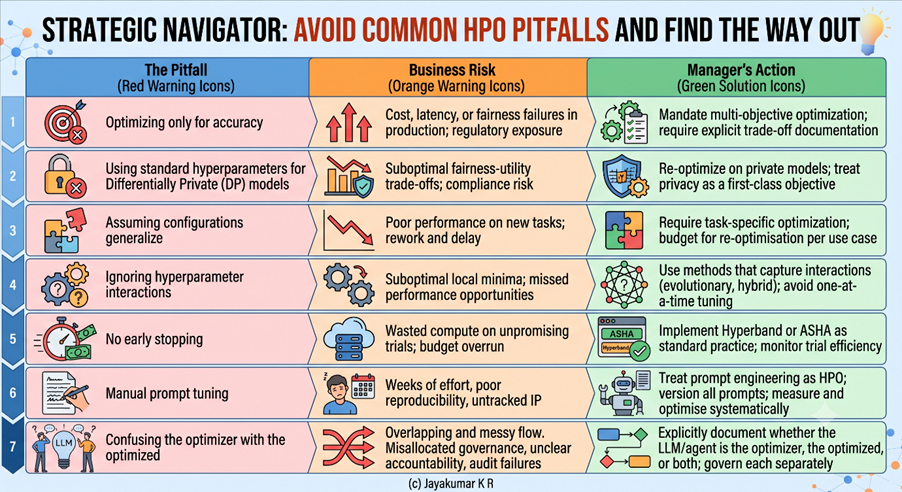
The choice of hyperparameters directly impacts not just performance but also cost, latency, and fairness. Optimization must consider the full system, not just the model. A configuration that achieves remarkably high accuracy but triples inference cost and introduces demographic bias is a governance failure waiting to surface.

The Optimizer and The Optimized
Before examining methods and tools, project leaders must internalize a fundamental distinction that is frequently blurred in technical literature:
The Optimizer is the technique or engine that searches for optimal configurations.
The Optimized is the system whose hyperparameters are being tuned.
These are independent dimensions. An LLM can optimize a traditional ML model. An agentic system can optimize GenAI inference parameters. The management task is to choose the right combination for the project and to govern both the engine that is used for optimization and the system being optimized.
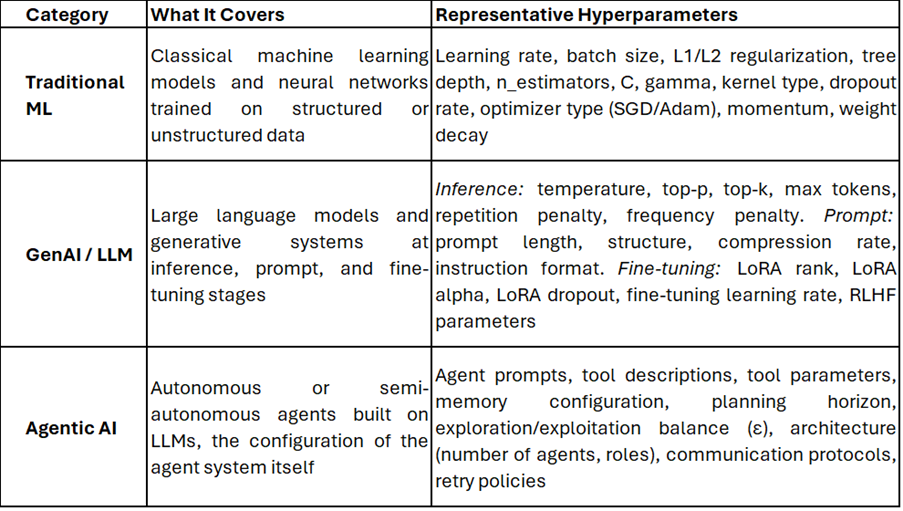
Dimension 1: The Optimized — What Is Being Tuned?
Dimension 2: The Optimizer — How Is the Optimization Performed?
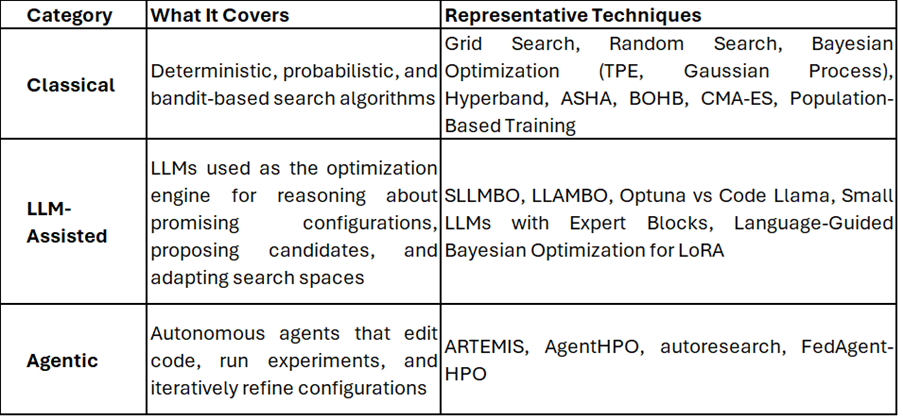
- Traditional ML HPO refers to the optimized being a traditional ML model. The optimizer can be classical, LLM-assisted, or agentic.
- GenAI-Specific HPO refers to the optimized being a GenAI/LLM system. The optimizer can be classical, LLM-assisted, or agentic.
- Agentic HPO has two distinct meanings:
- Agentic-as-Object: Optimizing the configuration of an agentic AI system.
- Agentic-as-Method: Using an autonomous agent to optimize traditional ML or GenAI including another agent.
Open-Source Gen AI Models and the Governance Boundary
The scope of what can be tuned and by whom depends critically on whether a model is proprietary or open source. For open-source models, the tuning landscape is fundamentally broader, and this has direct management implications. Training hyperparameters related to model quality, convergence, and overfitting are fully accessible to ML engineers and data scientists for open-source models. Inference hyperparameters related to tuning output quality, cost per query, latency, and safety are controllable by developers and sometimes by end users.
Application developers have broad and direct control over both training and inference hyperparameters for open-source models. This is a capability, but it is also a governance obligation. The more that can be tuned, the more that must be tracked, versioned, and governed. End-users, by contrast, gain access only to hyperparameters that developers deliberately expose through the product interface, typically limited to inference parameters like temperature (often presented as a “creativity” slider) or response length.
For open-source models, the technical capability for tuning is broad. The management task is deciding who is authorised to tune what, under what conditions, and with what tracking and governing that boundary continuously.
Optimizing Private Models
Private Models refers specifically to models trained with differential privacy (DP), a formal privacy-preserving technique that adds noise during training to protect individual data points. Differential privacy (DP) is a mathematical framework that guarantees that the inclusion or exclusion of any single training example has a bounded effect on the model’s outputs. It is implemented by adding calibrated noise during training (e.g., to gradients) and is used in sensitive domains like healthcare, finance, and government.
DP changes the training dynamics fundamentally. Hyperparameters that work well for standard training like learning rate, batch size, clipping norm, noise multiplier that interact differently under DP. The optimal configuration for a non-private model is not the optimal configuration for a differentially private model. You must re-optimise directly on the DP model to get good fairness-utility trade-offs.
If your project uses differential privacy for regulatory or ethical reasons, you cannot reuse hyperparameter configurations from non-private experiments. You must budget for a separate HPO process on the private model.
Building AI Project Management Capability
As the field evolves, the boundary between hyperparameter optimisation and system design continues to blur. The most successful teams treat HPO not as a one-time step but as a continuous discipline that adapts as models, data, and requirements change.
The Management Process
- Define objectives with stakeholder input.
- Specify the optimizer and the optimized.
- Choose methods aligned with budget and expertise.
- Implement tracking and governance from day one.
- Validate thoroughly and document trade-offs.
- Iterate continuously, building organisational memory through meta-learning.
- Meta-Learning for Warm-Starting: Building Organisational Memory, the practice of storing configuration-performance mappings enables meta-learning for HPO, where knowledge from previous optimisation tasks is leveraged to accelerate optimisation on new tasks.
This is how organisations transform HPO from a technical chore into a strategic capability, one that delivers predictable performance at controlled cost, with auditable fairness and safety.
Common Pitfalls: A Manager’s Red Flag & Action Brief
References
- Barker, M., Bell, A., Thomas, E., Carr, J., Andrews, T., & Bhatt, U. (2025). “Faster, Cheaper, Better: Multi-Objective Hyperparameter Optimization for LLM and RAG Systems.” ICLR 2025 Workshop on Foundation Models in the Wild. arXiv:2502.18635
- Brookes, P., Voskanyan, V., Giavrimis, R., et al. (2025). Evolving Excellence: Automated Optimization of LLM-based Agents. arXiv:2512.09108.
- Chen, Z., Connor, M., Pant, S., & O’Neill, M. (2025). Investigating Combined Algorithm Selection and Hyperparameter Optimization for Fairness. GECCO ’25 Companion, Malaga, Spain. ACM DL
- Choi, J. H., Zhao, J., Shah, J., et al. (2025). CompactPrompt: A Unified Pipeline for Prompt and Data Compression in LLM Workflows. 2nd Workshop on LLMs and Generative AI for Finance.
- Donato, B., et al. (2025). “Studying How Configurations Impact Code Generation in LLMs: the Case of ChatGPT.” arXiv:2502.17450.
- Ferreira, F., Wobbe, L., Krishnakumar, A., Hutter, F., & Zela, A. (2026). Can LLMs Beat Classical Hyperparameter Optimization Algorithms? A Study on autoresearch. arXiv:2603.24647.
- Kochnev, R., et al. (2025). Optuna vs Code Llama: Are LLMs a New Paradigm for Hyperparameter Tuning? arXiv:2504.06006.
- Mahammadli, K., & others. (2025). Sequential Large Language Model-Based Hyperparameter Optimization (SLLMBO). arXiv:2410.20302.
- Naphade, O., et al. (2025). Small LLMs with Expert Blocks Are Good Enough for Hyperparameter Tuning. arXiv:2509.15561.
- Seong-Eun, B., Jung-Mok, L., Sung-Bin, K., & Tae-Hyun, O. (2026). A Language-Guided Bayesian Optimization for Efficient LoRA Hyperparameter Search. ICML 2026.
- Shandilya, S., Xia, M., Ghosh, S., et al. (2025). TACO-RL: Task Aware Prompt Compression Optimization with Reinforcement Learning. Findings of ACL 2025, 1582-1597.
- syftr. (2025). Pareto-Optimal Generative AI. Proceedings of Machine Learning Research.
- “Turning up the Heat: Min-P Sampling for Creative and Coherent LLM Outputs.” (“Turning up the Heat: Min-P Sampling for Creative and Coherent LLM …”) (2025). ML Anthology. ICLR 202
All trademarks, logos, and brand names mentioned are property of their respective owners. References are for identification, commentary, or education only. No endorsement or affiliation is implied.
© 2026, Jayakumar K R. All rights reserved.
This article and all its contents, whether in this form or any other form, format, or media shall not be copied, reproduced, distributed, adapted, translated, or quoted in whole or in part without the prior explicit written permission of the author. Unauthorized use, sharing, or reproduction of this material is strictly prohibited.