
As AI systems grow more complex and autonomous, the gap between testing in controlled environments and real-world performance continues to widen. This investigation builds on our previous work, moving from what to measure to what & why to validate.
Why validation matters to you:
- Avoid costly failures: AI failures in production can damage reputation, incur regulatory fines, and erode customer trust.
- Meet regulatory requirements: Frameworks like the EU AI Act and NIST AI RMF demand demonstrable validation.
- Ensure business outcomes: Validation ensures your AI investment delivers the intended value.
- Enable safe innovation: Proper validation gives confidence to pursue ambitious AI capabilities.
Validation is not a one-time phase; it is a continuous discipline that must evolve with your systems.
Part 1: Validating Traditional ML Systems
Traditional machine learning systems, while simpler than generative AI still require rigorous validation approaches.
Cross-Validation: Ensuring Reliable Performance Estimates
A technique that tests model performance across different subsets of your data to ensure results are not just lucky.
Key management considerations:
- Right splitting: Your data’s structure dictates how you should split it for testing. For time-based data (sales forecasts, customer behaviour over time), ensure you never test on data from the past using information from the future as this creates misleadingly optimistic results.
- Repeated Testing: For small datasets, use repeated testing to get stable performance estimates.
- Comparative Statistical Evaluation: When comparing models, apply statistically sound comparison methods rather than relying on a single performance number.
The standard approach to cross-validation can accidentally create overly optimistic results for time-series problems. Always ensure training data strictly precedes test data chronologically.
Best practice: When tuning multiple candidate models, use a nested approach, an inner process for optimisation and an outer process for honest performance estimation.
Controlled Rollouts: Safe Deployment Strategies
Traditional A/B testing has been extended for AI systems with four proven deployment strategies:
- Shadow Testing: Run new model alongside production model without serving its outputs to users; compare performance offline.
- Canary Deployment: Roll out to 1% of users first, monitor closely, then gradually increase.
- A/B Testing: Directly compare two versions with random user assignment.
- Interleaved Testing: Interleaving is used in LLM evaluation by mixing outputs from two or more models into the same user interaction so that user behaviour directly reveals which model performs better.
Best practice: Start with a 1% canary cohort, review performance signals continuously, and enable automated rollback if targets are breached. Many production incidents can be avoided when teams follow staged rollouts.
Part 2: Validating Generative AI Systems
Generative AI introduces challenges traditional approaches were never designed to address:
- Probabilistic outputs: Repeated inputs do not guarantee identical outputs.
- Infinite variety: Offline scores on golden datasets cannot predict performance with real-world user inputs.
- Emergent behaviours: Unpredictable interactions across long conversations.
Output Consistency Testing
GenAI models often interpret repeated prompts as a signal to diversify responses, introducing variability that complicates testing and automation. Track consistency as a key quality indictor. Even with models configured to be deterministic, expect accuracy variations between best and worst performance.
Evaluations to consider:
- Early-stage stability: How consistent is the model at the beginning of interactions?
- Recovery patterns: How does the model respond to challenging follow-up scenarios?
- Repeatability: Consistency across repeated runs under identical conditions.
- Reproducibility: Consistency across runs under different conditions.
Human Preference Scoring
Reinforcement Learning from Human Feedback (RLHF) remains central to aligning AI with human values.
Approached to consider:
- Generative reward models: Novel approaches like generative reward models achieve high accuracy in predicting human preferences.
- Generative RLHF-V: Specialised frameworks such as Generative RLHF-V improve multi-modal LLM performance across benchmarks.
- General preference optimization: General preference optimisation with reward-based RLHF is another technique emerging as a superior approach.
Most preference benchmark labels are generated synthetically. Teams must maintain real-human agreement validation on internal hold-out benchmarks. There is no substitute for checking against actual human judgment.
Conversation Log Analysis
Analysis of production conversations has emerged as a critical validation technique. However, reliability remains questionable due to hallucinations, misinterpretations, or fabricated responses. Studies using advanced models for automatic analysis of real-world customer care conversations highlight key areas where even state-of-the-art models fail.
Intent Alignment
Traditional accuracy indicators do not measure whether the AI serves the user’s actual goals. Models can produce factually correct outputs that completely miss what the user needed, a phenomenon called “Intent Hallucination.”
Validation approaches:
- Human-centred evaluation: Assess systems across multiple dimensions including intent alignment, explanation quality, interaction naturalness, trust & transparency, and fairness.
- Structured intent representation: Using frameworks (Who, What, When, Where, Why, How, How much, How many) improves intent alignment.
Semantic Accuracy
Standard accuracy indicators that look at word overlap (like BLEU and ROUGE) fail to capture whether an output actually means the same thing as a reference answer.
Validation approach: Evaluate whether a model’s output means the same thing as a reference answer, tolerating paraphrase and word-order changes.
Emerging evaluations:
- Constraint‑Accuracy Split: Tests measuring constraint compliance separately from semantic accuracy. (Ex., Compression-Decay Comprehension Test)
- Structure–Content Split: Frameworks that decouple structure from content to evaluate meaning independently.(Ex., Table-BiEval)
Behavioural Consistency & Stability
Research reveals a persistent instability in LLM behavioural patterns across scales and mitigation strategies, suggesting current LLMs lack architectural foundations for genuine behavioural consistency. For safety-critical applications, current alignment strategies may be inadequate.
Validation frameworks:
- Behavioural Consistency: Evaluate stability indicators including response consistency and semantic similarity.(Ex., Statistical Framework for Behavioural Consistency Measurement – SFBCM)
- Behavioural Steadiness: Evaluate how consistently models behave across millions of responses over time. (Ex., PERSIST framework)
Part 3: Validating Agentic AI Systems
Agentic AI demands the most significant paradigm shift in validation. These systems:
- Plan over multiple steps
- Make decisions over time.
- Interact with tools and external systems.
- Adapt to changing contexts.
An agent’s behaviour is shaped by its goals, memory, environment, and prior actions. Failure modes emerge only after a sequence of decisions unfolds. An agent can pass every unit test and benchmark and still fail catastrophically in production. Even the most leading agents can skip a few complex tasks autonomously, underscoring the importance of rigorous agentic evaluation.
Goal-Tree Verification
Decomposing high-level objectives into verifiable sub-goals. The goal judge may mark a goal as “DONE” based solely on textual claims without verifiable evidence. Goal verification must require verifiable evidence, not just textual claims. This means you need to see actual outputs or actions, not just hear that something was done.
Replay Auditing
Re-running a production agent’s recorded execution against its own history, across different environments, and against its own instrumentation. This enables detection of drift against the agent’s own historical behaviours like were past decisions traceable and do current decisions follow similar patterns?
Failure-Mode Testing
Creative Adversarial Testing (CAT): Evaluating goal-oriented agentic systems using synthetic data for comprehensive testing of edge cases and failure modes while protecting user privacy.
Environmental diversity: Environmental diversity in testing may identify significantly more potential failure modes than single-environment testing.
Multi-Agent Conflict Resolution
When multiple agents interact, conflicts must be validated. Approahces:
- Ethical dilemma resolution: Resolve complex ethical dilemmas through adversarial reasoning, achieving improvements in decisiveness and ethical compliance.
- Conflict resolution: Conflict resolution approaches using formal argumentation for multi-agent requirements negotiation.
Capability Validation
Before committing to an agent approach, validate critical bottlenecks:
- Tool execution reliability: Can the agent reliably use the tools it needs?
- Autonomy assessment: How often does the agent require human intervention?
- Cost validation: What is the cost per successful task?
Common Sense Testing and Sanity Checks
Commonly adopted indicators often fail to detect inconsistencies obvious to domain experts or violations of fundamental principles. Testing thousands of questions across hundreds of mainstream models revealed “commonsense blind spots” in their world models. Smaller models can outperform larger ones in commonsense evaluation compared to human population judgments.
Practices:
- Guardrails: Automated, programmable safety mechanisms enforcing domain constraints.
- Sanity checks: Logical or statistical verifications, schema validation, factual consistency tests.
- Lightweight sanity checks: Use reasonable perturbations to screen whether outputs have found stable signal or are responding to noise.
Begin with a short sanity check on a few real examples. Stop if you encounter critical errors. Then proceed to stability tests.
Guidelines to Choose Your Validation Techniques
- Risk level: High‑stakes (healthcare, finance) need rigorous validation (bias, performance); low‑stakes (entertainment) can do with lighter testing.
- Regulation: Comply with EU AI Act, NIST RMF, sector rules. Set minimum standards for validation and documentation.
- AI System type: Deterministic ML (accuracy/calibration), GenAI (factuality, safety, hallucination), agentic (planning, action safety), each requires distinct checks.
- Stakeholder trade‑offs: Balance explainability, privacy, cost, and speed per use case when selecting techniques.
Summary: Quick Reference
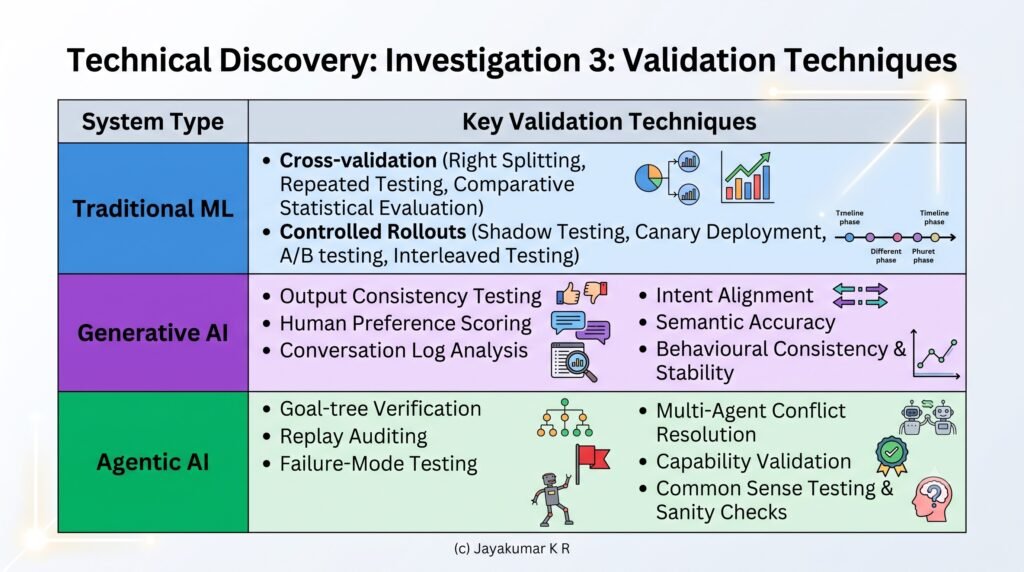
External Validations:
Industry Benchmarks
Beyond internal validation, teams should stay aware of industry-wide benchmarking efforts.
The Artificial Analysis Intelligence Index (AAII) is a composite benchmark aggregating nine independent evaluations across four categories: coding, knowledge, reasoning, and safety.
Use Cases: Model selection, challenge testing, cost-benefit analysis, continuous monitoring.
Caveats: This is a single composite score that hides the shape of a model’s strengths. Version changes cannot be compared directly. Deployment factors often matter as much as just intelligence.
One model recently topped the AAII with a record score, claiming savings of “an estimated 25% less” on typical work. But
- A max-effort task cost 20% more because the model writes roughly 1.7x the text.
- Safety filters get applied 60% less on cybersecurity work and 85% less on basic medical questions compared to the previous version.
Lesson: Benchmarks are useful tools but cannot replace your own validation in your specific context.
“LLM-as-a-Judge” as a Validation Tool
“LLM-as-a-Judge” uses a powerful LLM to assess another model’s output quality. While promising, its reliability remains an active research area. You can use it for Model screening, Regression testing, and for Large-scale data annotation, providing quality scores for thousands of outputs.
Best practices for reliable use:
- Maintain a “gold” human validation set: A small, high-quality dataset annotated by human experts to calibrate and validate the LLM judge.
- Use a more powerful judge model: Ensure the judge is stronger in instruction-following than the model being evaluated.
- Consider “LLM-as-Jury”: Use multiple LLMs as judges with voting or consensus to reduce individual biases.
- Conduct regular human spot checks: Periodic manual checks to ensure the judge’s assessments remain aligned with expectations.
Validation is not a phase; it is a continuous discipline that must evolve with the system. The techniques within each layer must be continuously updated as models drift, new architectures emerge, and requirements evolve.
Recommended Reading
For those who wish to explore specific techniques in greater depth, the following references provide technical detail and empirical findings:
- A nested model for AI design and validation (iScience, 2024)
- Testing and validating agentic AI, the need for new approaches (ValidMind, 2025)
- Controlled strategies like canary and A/B testing (AI 4U Labs, 2026)
- Position-Weighted Consistency and Multi Turn (MT) Consistency benchmark (ACL 2025)
- Beyond Facts, evaluating intent hallucination in LLMs (ACL 2025)
- Behavioural Consistency: Persistent instability in LLM personality measurements (AAAI 2026)
- Agentic Evaluation: Creative Adversarial Testing for goal-oriented agentic AI (arXiv, 2025)
- Common Sense Testing: Core knowledge deficits in multi-modal language models (ICML 2025)
- Human Preference: General Preference Optimization for language model alignment (ICML 2025)
- Industry Benchmarking: Artificial Analysis Intelligence Index (artificialanalysis.ai)
© 2026, Jayakumar K R. All rights reserved.
This article and all its contents, whether in this form or any other form, format, or media shall not be copied, reproduced, distributed, adapted, translated, or quoted in whole or in part without the prior explicit written permission of the author.
Unauthorized use, sharing, or reproduction of this material is strictly prohibited.